Saturday, April 14, 2012

Bikkies and thistle leaves

Tonight I sat down in our kitchen and made a skirt. Nothing at all unusual about that - it is by far and away one of the most lovely ways to spend an evening, sitting and sewing in my favourite room in the house, with Pearl by my side cooking/writing/reading. What could be better?

But tonight was special, because tonight Pearl was baking mountains of macadamia, honey and white chocolate biscuits to feed to our house-building friends who are all arriving tomorrow. Unbelievable excitement!!! Even through the exhaustion!

Pearl worked all day today, cooking at Evolve, so I was on kid duty. We did the usual kinds of things: perusing Bega Ag Supplies, perusing Bega Bolt Barn, perusing Mitre 10, eating some junk food and half-price easter eggs, perusing the op-shops and then heading up to the land to Build Some Stuff. Awesome. Under construction today was a frantic last-minute shelter for the composting dunny my dad is bringing with him tomorrow. This was one of those jobs that desperately needed attending to, but that just somehow never quite made it to the top of the list. So today, with 48 hours to go, I decided that the best I could do was hammer 4 star pickets into the ground (with my brand new, bright red picket-driver) in a vague square shape (no measurements or levels were involved in this highly technical piece of construction) with the intention of draping a sheet around to provide some semblance of privacy for those using the composting loo. Loo with a view to be 'completed' tomorrow using the very fetching yellow and orange striped sheet I picked up at the op shop today for a buck. Hopefully no prudes on the work crew...

Kids played happily on piles of sand and Olive very attentively made sure that all pieces of gravel were safely in their place within the confines of the bottom plate.
It was beautiful, and for the first time in... well, weeks, I felt pretty relaxed!

The maca/honey/white choc-infused skirt is for a lady who hails from Castlecrag, who was lucky enough to come across a horizontally-oriented teatowel in her travels. If there are any teatowel enthusiasts reading this, you'll well know that horizontal orientation in teatowel design is pretty rare. I can't work out why this is, as they're pretty awesome, and especially great for making skirts out of.
This teatowel is particularly unusual, I reckon, on account of the outrageous level of detail the artist has included in her rendering of The Vegetable Garden at Heligan, including the names of all the vegetables in the rows and, most awesomely, the manure heap.
Fundamental to the health of the garden! Though I'm not convinced about those fanatically neat rows...

Teamed with a bit of dusty blue corduroy, pink ric rac and a print called 'thistle leaves', it makes a pretty cute skirt, which will hopefully also be comfy, on account of its wide stretchy waist-band.
Here's hoping the skirt and its owner enjoy many an outing to a rambling garden with an abundance of manure-heaps!

Friday, April 13, 2012

Apprentice to the apprentice


It's pretty hard to describe the feeling and emotions going on in our house at the mo, being as we are 2 days out from the workshop. It's crazy levels of all hands on deck.

Pearly's writing shopping lists and menu plans and making sure kids are happy and fed and at least partially clothed!I'm pretending that I don't actually work full time, and utilising every second of my lunch-break to pick up second-hand building materials obtained on freecycle, and finalising and confirming orders and deliveries over email so my boss doesn't hear me on the phone. Louisa's trying to get snippets of work done in between looking after kiddies and cooking delicious dinners. And Morag, well, Morag's kind of making it all happen, receiving orders of sand and gravel at the land, chasing window-framing timber all around town and, tonight, teaching me how to make window bucks and frames. Morag's immense helping-ness is actually kind of freaking me out, because I'm looking at everything she's doing for us, and I'm thinking that if she wasn't here I'd be doing it by myself, and that thought is, quite frankly, terrifying.

The window bucks are the rough frames that are inserted into the strawbale walls as they're put up, and then the proper window frames are fixed into these. The window bucks are made from treated pine, and are then covered in render, so you don't see them. Yes, I know treated pine isn't at all great, and doesn't really fulfil our non-toxic ambitions, but you know what? Sometimes you just have to make a pragmatic compromise, and a small amount of treated pine timber used for framing up our windows is one of our compromises. Especially at this stage in the game, with the beginning of the workshop looming and a list a mile long still needing to be attended to, I'm pretty cool with using ye olde treated pine. It's so soft to drill!
So last night and tonight were spent measuring and cutting (with big, fancy tools like mitre saws!) and drilling and screwing together our window bucks. It was pretty exciting, after we got over a few false starts involving incorrect measurements and me cutting on the wrong side of the line. Morag is an excellent instructor, and was very patient and encouraging with me, even when I clearly did not have any clue what I was doing. Yet another reminder that, as much as I fantasise about actually living in the middle of nowhere and actually building my own house all by myself, a house built under those circumstances would probably be pretty crap.

It was interesting for me to observe the way that I, the untrained seamstress, differed from Morag, the carpentry apprentice, in my approach to measuring the timber sizes. In the same way as I built the chicken house at our old place in Sydney,
my inclination is to always measure things as if I'm going to stitch them together. Morag quickly showed me that this was not an approach to take with carpentry, especially when it's going into a building that has to be, well, kind of square. I was familiar with the disastrousness of not-square buildings from reading A Place of My Own by Michael Pollan, so was keen to avoid anything of the sort in our own little house. I took Morag's lead and measured to the millimetre. Thing is, when you're using big cutting machines with blade a mill thick, you wanna make sure you cut on the right side of the bloody line! learned that lesson a couple of times... pretty sure I'm good with it now.

In addition to the fancy electric tools we also made use of other quality tools like ugg boots (in lieu of clamps) and iphones (in lieu of a calculator or skills in mental arithmetic).
The windows and doors to be encased by these newly-made bucks are many and varied, originating from side-of-the-road council clean-ups (federation era bay window re-made into double casements and a gorgeous set of solid French doors), gifts from friends (wonderful art deco leadlight) and one of my mumma's trips to the op-shop (unusual and gorgeous tiny leadlight). The photo below shows some of our completed bucks, braced diagonally to keep them square, and some of the stripped federation side-of-the-road windows, which Morag and I picked up about 2 years ago.
There have been many hours spent stripping the paint off these mongrels, a task I would shudder to attempt without the aid of my trusty Bahco paint scraper. This was recommended to me by my boss, who is an almost bottomless font of knowledge of all things building-related, and very keen on drawing diagrams to accompany his advice, much to my amusement and appreciation. He told me that this tool, because of it's awesome ergonomics and efficiency "makes scraping fun. Almost". Quite the caveat, but true nonetheless.
Now that they're almost stripped, I'm quite pleased, and think it was definitely worth the work, though a couple of them need some repairs given that the million layers of paint were apparently the only thing holding them together. No worries though. I soon made friends with Builder's Bog, and will be fixing the windows as soon as the frames are done and time allows (cue guffaws of laughter here).

But seriously. We're now at the stage where we can actually say that, this time next week we'll be able to stand inside our little strawbale home and look out those windows, after having spent a week building it with some of our nearest and dearest, and a few new friends as well. I can't imagine what that will feel like, but I guess we're soon going to find out!

For those of you who are interested in what we're spending on this adventure, additional framing timber for the windows has set us back $350, and the sand (for rendering) and gravel (to fill the bottom plate) was $400.

Tuesday, April 10, 2012

Drilling holes in concrete is really, really hard

When we were fretting about not having our footings poured in time for them to "go off" before the workshop, my dad consoled me by pointing out that at least the concrete would be a bit softer when it came time to drill in and attach the bottom plate. Turns out my dad's idea of 'soft' isn't really what I was thinking of.

This evening, with the help of our amazing, talented and generous friend Morag, the bottom plate was securely attached to the footings, but not without a small number of hindrances, mostly due to my own ignorance of the processes involved with drilling into concrete.
Lesson number one: an 18 volt cordless drill is NOT powerful enough to make holes in concrete. Lesson number two: cheap, crappy generators from Mitre 10, bought on the spur of the moment out of feelings of frustration will probably turn out to be cheap and crappy and not actually work properly.

But today, after returning the cheap and crappy generator and hiring a 'proper' generator to power my dad's 240 volt hammer drill, Morag and I drilled 70 holes into the concrete footings and bolted that bottom plate down while Meg, Pearl and Louisa kept the home-fires burning, making dinner and looking after the kids.
The generator made a ton of noise, and the drill, hammering away through the concrete and blue metal, was quite hard on the wrists and shoulders, but I tell you: having that thing finally in place was quite rewarding, probably on account of it having been quite an ordeal and taking quite a lot longer than I had planned.

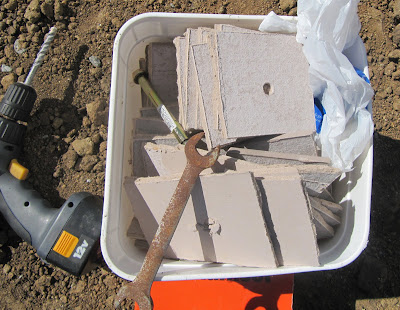
The bottom plate assembly on our place is a little more complex than your standard bottom plate for a few reasons. Firstly, it's made up of 2 rails, 35cm apart, to hold the width of the strawbale walls. It's also slightly raised, thanks to 9cm squares of villaboard which I lovingly cut and pre-drilled in preparation for their special task of raising up the timber rails.
The reason the rails need to be raised is twofold: the 6mm gap created by the villaboard packing allows any moisture to escape under the timber without causing rot, and it also creates a gap underneath the bottom plate assembly for us to push through the high-tensile fencing wire which will be used to pre-compress our strawbale walls before the render is applied.
Now I know that if you are not familiar with strawbale construction this probably all seems kind of weird and maybe even boring. If you're feeling bored, I apologise. I can only say that I'm including these details in the hope that it will help out the people who are interested in strawbale construction by allowing them to learn from our mistakes.

But enough with the disclaimers. The rails of the bottom plate have now been attached using dynabolts.
We worked into the night, turning on the car's high beams so we could see the pre-drilled holes, and then relished the sound of the wind through the trees when we finally, after an hour-and-a-half of generator-ing and super-power-drilling, turned off the power.
We returned home to our women-folk and kiddies, tired and sore and pretty chuffed with our success. We drank Pepperjack beer and ate mushroom risotto and wrote lists for the days ahead. Morag and Louisa are the first of our friends to arrive for the little-house-building. They've put in a mammoth effort to be here with us, amidst personal turmoil and family weddings. We feel so blessed to have them involved with this, our biggest craft project, and can already feel the love being poured into our new home, even though there's nary a wall yet built. Oh to sleep under that roof of love!!!

Friday, April 6, 2012

In pursuit of a bottom plate (part one)


We have 9 days until our workshop. There is much to do. Yes we have managed the excavation and the footings, and while we are thrilled we managed all this against the (weather) odds, we can't allow complacency to creep in. There's a little more we need to have done before 8am on Monday 16 April. Part of the understanding we have with Frank (strawbale builder) Thomas is that we will be ready to start building the strawbale walls on Monday morning. What this means is we need to construct the 'bottom plate'. The bales will be attached to the bottom plate which will be attached to a "top plate" on top of the bales. The roof is attached to the top plate. As there's no frame on this little strawbale, this is what we need to do to ensure our building is structural. Our little straw bale is what is known as "load bearing" strawbale. And this is the main reason for our over-engineered footings. Yes we (and the earth) have paid the price for legitimacy.

Look, I don't know about you but I find this top plate, bottom plate bizzo all a bit tricky to understand. I am seriously challenged when it comes to anything conceptual. I don't know what happened to me. I suspect, the largest part is growing up a book and art loving girl in our gender divided culture. It's like part of my brain got switched off to the point where try as I might, I find this stuff so hard to understand. My lack of understanding is such that when Annie said we needed to head to the land this morn to attach the bottom plate, I actually had no idea what she was talking about.

So we're a bit of a bumbling building duo. We lost the essential drill bit that would allow us to finish the bottom plate task. However we were able to measure and cut the wood. The best way I can describe it is that we were making a kind of timber frame that will sit atop the footing and contain blue metal, a board will sit atop this (drilled in of course) and from here we will start laying the bales. They'll be laid somewhat like bricks.... I'll stop there, best for there to be photos to complement the further detail.
So we spent the glorious morning with sun on our faces and a delicate north easterly breeze in our hair measuring and sawing timber. Yes pine. I think I'll leave the discussion about the ethics and toxicity of timber to another blog post. But if you're interested, in the meantime, Milkwood have a useful discussion on the issue. Oh like so much it's a veritable minefield of ethical dilemma fused with financial constraint. Eek!

It was a task that would take some people an hour. It took us three. We had kids to attend to, measurements and diagrams to check and double check and the fact that our tools were pretty much all wrong for the task. Oh but we are happy. I felt pretty chuffed when we'd measured, sawn and laid out all the timber. So happy I forgot to take a photo. And the kids were happy to have our attention again. They played together and apart. Oscar had been devouring the slopes with his new balance bike while Olive had found a shady spot under a tree for some reading and maths(!). On the issue of maths, well, that is totally self-directed. We're not the hot housing types, I promise. She just decides to do sums sometimes.

After all that calculation, it was time for lunch in the shade of a mighty 500 year old Angophora with views down the valley. Calzone with tomatoey basil sauce + olives + mozzarella made this morning were first up followed by local fruits, bliss balls and tea. Pretty satisfying.
Friends start arriving this week and I need to start baking - biscuits and cake and spice mixes and all manner of general deliciousness to feed the generous and sweaty workers. Exciting times ahead.

On the issue of costs, the timber for the bottom and top plates and window frames (more on this at a later date) was $1,500. After the roof trusses, that's all the timber we'll be using. So far everything is fitting nicely within our budget. Let's hope it stays this way so we can purchase more trees and plants for garden abundance.

Thursday, April 5, 2012

Oh you know you want to...

Unless you're reading this blog for the very first time you probably know that we are hosting a strawbale building workshop on our property from April 16 - 20. Frank "If it's not strawbale, it's not worth doing" Thomas is running the workshop. He has done many marvellous buildings big and small, all around the place. Anyway our workshop was full but as is the way with life, some big things have cropped up for some people and now we have two spots free. Any takers? We will feed you and accommodate you and look after you and thank you wholeheartedly. In return you get to spend a week using muscles that may not have been used for some time, maybe make some new friends, eat some fine foods, enjoy our lovely vista and learn from a very learned builder. The far south coast is especially spectacular at this time of year and if you want to stick around afterwards we will continue to feed you and accommodate you and helpfully point you in the direction of some splendid beaches or the Quaama Harvest fair on Saturday 21st April. Kids are very welcome. In fact we've ordered extra bales just for them. Yes it's late in the day and you probably have plans the week of the 16th April, however if not, send us an email - pearlandelspeth@gmail.com
Thanks xx

Wednesday, April 4, 2012

Sharyn and Swampy sittin' in a tree...


Sharyn and Tom (Swampy) of Wandella, are the parents of our friend Carly, who is one of the highlights of our new-town-friend-making adventures.

One day soon, they'll be celebrating their 30th wedding anniversary, and to mark the occasion, Carly was thinking pearls, as these are the traditional gift for 30th anniversary celebrations. Carly figured she couldn't really afford real pearls for her Ma, but thought maybe a Pearl & Elspeth might be a reasonable second. I was thrilled and honoured to be involved in such a gift and immediately set to work brainstorming with Carly about what kind of P&E to make for her parents.

I first met Sharyn and Tom at their pretty awesome handmade home in Wandella when we went to Carly's Blue Light Disco themed 30th birthday party. The party was rockin', with a band, animals on spits, a jumping castle, tons of people dressed in incredible 80s-wear, kids running around feral, a lotta love and a massive bonfire - exactly the kind of party I want to throw sometime. I had already pretty much sussed that Carly was rad, but when I met her folks and (5) siblings and saw the place they all grew up I began to understand the reason Carly is so rad, and I felt really happy.

The gift-making was based around the following criteria: Her ma likes my skirts, digs owls ("Put a bird on it!") and loves and looks awesome in autumnal kinds of colours. Her dad is a "butch yobbo"/"earthy kinda dude" who would probably appreciate a lounge-y kind of item like a cushion or knee-rug for snuggling, and who wears heaps of black denim and flannos. What a brief!!! The answer to this brief was (of course!) a skirt for Ma featuring Sharyn and Tom rendered as owls in applique,
and a black denim and flanno owl-shaped cushion for Pa.
Getting a 2nd-hand flanno to use for this project proved to be quite problematic, given that op-shops in the far south apparently do not put flannos out until after easter (!) so I ended up using my own, favourite flanno, unwashed, to make the body of the owl.

This was an interesting exercise for me, and a good test of my newly-embarked upon philosophy of letting go of 'stuff', which has been quite profoundly influenced by my readings of Little House on a Small Planet and Radical Homemakers. But it was actually kind of easy, once I decided to do it, because I just knew that the joy that Carly, her Ma and Pa would get from the re-made shirt was way more than my attachment to the flanno itself, so hack it I did, to the soundtrack of Olive shrieking "Ami!! Why are you cutting up your shirt!!???".
I reckon it was worth it.
In other news, due to popular demand, I am posting the apple jelly recipe so that others can experience the labour-and-energy-intensive deliciousness that is apple jelly.

Ingredients
4 cups apple juice (approximately 1.35kg apples and 3 cups water)
2 tbsp lemon juice (if desired - I put it in)
3 cups sugar

To prepare juice
Select tart apples (I'm pretty sure the variety we used were Spartans, but when it's the side of the road you can never be 100% sure) - about 1/4 firm and 3/4 fully ripe. Remove the stems but don't peel or core them, just chop the whole apples up and put them in a saucepan with the water. Bring to the boil the reduce to a simmer until the apples are soft. Extract the juice by hanging the boiled apples in some muslin over a bowl. Squeeze it out to make sure you get all the goodness!!

To make jelly
Measure the apple juice into a saucepan and add sugar to the ratio in the recipe ingredients (for example, I had about 12 cups of juice, so added 9 cups of sugar). add lemon juice, if you want to, and bring to the boil, then reduce to a simmer. Now cook the crap out of it until it 'sheets' off the spoon (this means that when you pour off the spoon it falls in a 'sheet' rather than a 'line' (if this doesn't make sense, email me).
Remove from the heat and skim off all the foamy scum (I was quite fanatical about this and did it continuously throughout the simmering process).
Pour the jelly immediately into warm, sterilised jars (I filled mine with boiling water, let them sit for about 5 minutes, poured out the water, then put them in the oven). Wipe the rims, put the lids on, then process them in a boiling water bath for about 10 minutes.

Try not to eat too much of the warm jam directly off the spoon while you're cooking because, though delicious, in large quantities it' actually kind of nauseating.

Good luck! Enjoy!

Sunday, April 1, 2012

This weekend we...

Received a ute-load of pallets and timbers and fence-palings and windows and doors.
These had been left at our old house in Sydney, and were lovingly delivered by Pearl's parents, who came down for a visit. These will need to be stripped, and frames will need to be constructed, all in the next 2 weeks before our workshop. Oh lordy...

Continued with the apparently never-ending job of preserving side-of-the-road apples.
Even after apple chutney and apple pies and stewed apples and sending several kilos to the lovelies at Cornersmith, we still have a mountain of apples on our kitchen bench. Yesterday while Pearl was at work I set to making some apple jelly using a recipe given to us by our lovely new friends Sara and Cam, who I was lucky enough to meet after getting involved with Bega Valley Swapsies. Sara and Cam have been tending their little acres at Upper Brogo, hand-building their own home, making food forests and ridiculously glorious swimming-dams for the last 10 years. Theirs is, quite frankly, the most inspiring property we've seen in the area, and a delicious glimpse of what could be possible for our little block if we work hard and concentrate the way these guys do. And in an area of inspiring and beautiful properties, that surely is saying something! These guys have also been hard at work preserving apples in the last weeks, and were happy to share with us their amazing jelly recipe.

It was, shall we say, a very involved process, which first involved boiling the crap out of the apples to remove their juice, straining and pressing through muslin, measuring and mixing with sugar and lemon juice, boiling again, skimming off the frothy scum on the top (which was, by all accounts, delicious, but this jelly is going in the Bega Show next year, so needs to be pure), pouring into sterilised jars then processing in a boiling water bath. Yep: The oven was on for a really long time today, and the whole shebang led me to conclude that apple jelly is not the most energy-efficient method of preserving yer apples, and definitely a bit of a treat. Not to mention freaking delicious.
Next stop, apple cider.

Cleared some of the rubble, loose stones/clay/leftover concrete and lumpy dirt out from inside the footings.
This is in preparation for the workshop, in 2 weeks time (oh lordy...), to create a reasonably level work area within the cottage, and to make sure no-one trips over anything while trotting around carrying a 30kg strawbale. It is also in preparation for our earth floor, which we will be laying after the workshop. We figure it's about a billion times easier to shovel all that crap out while there are no walls, rather than trying to do it with only the door and a couple of windows for openings.

Seeded the batter above our house-site with lucerne seed in anticipation of the rain that came rumbling over the hills this afternoon.
There is a lot more of the site that needs seeding, but most of that area is going to be used for storing strawbales before and during our workshop, so we're seeding it after the studio is built in 2 weeks time. Oh lordy... There are several reasons we're taking this seeding business quite seriously. One is to try to make sure the newly-exposed earth is stabilised against erosion, so that it doesn't all end up washed down to the bottom of the gully the first time we get a big downpour. We also want to try to get some useful plants growing, in lieu of the weeds that had previously populated the hillside. We're basically sowing leguminous nitrogen-fixers and green manures to try to prep the soil for the food plants we will eventually be planting (once the strawbales have all been moved and made into walls (!) we'll be sowing the entire space with billions of broad beans, more lucerne, cow peas, mustard, parsnips and peas). We also want to rebuild as much topsoil as we can. The thing about excavating a level spot on the side of a kind-of-steep hill is that, even if the excavator removes and stockpiles most of the topsoil before he starts really moving stuff around, you're still going to end up with way less than what you need to re-cover the area you've exposed. This isn't great when you have expansive veggie gardens/food forests/orchards in mind, so soil-building via the use of green manures and other beneficial crops, is top of the list of "what to do first thing after you have major earthworks done" (doesn't everyone have one of those lists??).

And yes, even with all this going on, we still feel that it's worthwhile to co-ordinate Oscar's socks with the rest of his working outfit.