Showing posts with label pastured poultry. Show all posts

Friday, April 10, 2015

Autumn Farmers wanted!!!

We Autumn Farmers would really love to enable and educate anyone at all who is interested in learning the ins and outs of pastured-chicken farming. So we're very excited to announce 2 opportunities right here on our farm, for all you budding chook farmers.
The first is Autumn Farm Chook School, which is a one day intensive held right here on the farm on Sunday the 14th of June. We'll introduce participants to all aspects of our CSA, from day old chicks to slaughtering and marketing. There'll be a tour of our little community abattoir and a delicious farm lunch, as well as theory and practical hands on activities. Spaces are limited, so please email us if you're interested.
Chief farming lady Pearl, in one of her many delightful floral aprons
The second exciting thing is that we are looking for a passionate, engaged, hard-working intern to join us for 3 months of learning, working, and chicken-wrangling. We are also in the process of hand building a strawbale home, so there is also an opportunity for you to participate in and learn about natural and strawbale building, if you’d like.
Tiny offgrid strawbale house
As an Autumn Farm intern, we would anticipate that you would work an average of 4 hours per day, 6 days per week, at tasks including (but definitely not limited to!)
-all aspects of chicken farming, from caring for day old chicks, moving the pasture houses, feeding, watering, transporting,  slaughtering and marketing
- construction: there’s always something being built, whether it’s a composting toilet, a brooder house, a chicken tractor or a strawbale home
- vegetable-growing: we grow food for ourselves, and occasionally sell excess to local cafes and shops
- compost-making: we make hot compost using waste from the abattoir
- bee-keeping: we have a Kenyan top-bar hive
- cooking and preserving
- this year at Autumn Farm we will also be running a pasture cropping trial, planting a food forest, and introducing sheep into our pastured farm enterprise, so it’s likely you’ll get a taste of all of these fun things too.
The view down the valley
We will provide you with a rich learning environment, with opportunities to learn everything you need to know about running a pastured poultry CSA and a small community abattoir. We have a cozy caravan for you to sleep in, and will provide you with healthy and delicious omnivorous meals. Bathing infrastructure at Autumn Farm is fairly rudimentary, so if you’re not going to be happy with an outdoor solar shower and the odd fire-bath, this probably isn’t the right job for you.

We ask that you are
-self-motivated
- aligned ethically with the ideals of sustainable, regenerative agriculture and/or permaculture principles
-prepared to do the work that needs doing
-willing to agree to a one-week trial on our farm

We are willing to consider couples and/or families, though the caravan is equipped only with a double bed. We are also happy to support writers, artists or other creative people who would like a peaceful place to live and work in exchange for helping on the farm.

If you are interested in coming and sharing in our farm, please send us an email – autumnfarmbega@gmail.com - telling us why you’d like to come to Autumn Farm. What are your inspirations and aspirations? You don’t need to have any experience, but you do need to be willing to learn and work hard.

How exciting is that? We're super excited about meeting some new people and sharing in our knowledge, so if you or someone you know is interested, please please PLEASE send us a message!


Photos of our farm by Jay


Sunday, November 23, 2014

Autumn Farm Chook School Part 2: 4 days old

In the last little Autumn Farm Chook School video you had a peek inside the brooder house, at the day old chicks.

In this video, you'll see the same chicks at 4 days old, on their first day outside of the brooder house, enjoying the sunshine and grass that makes them the tastiest, healthiest chickens around.


Saturday, November 1, 2014

Autumn Farm Chook School

It's been a little over a year now since the first Autumn Farm pasture raised chickens graced the dinner tables of the Bega Valley.

In the last 15 months or so we have learned an INSANE amount, including, but definitely not limited to, 'Dogs are way better than electric mesh fencing' and 'How to run a farm single-handedly while your partner suffers through cancer treatment'. While the learning definitely isn't over (though hopefully we're done with that last lesson), I feel like we've got a good handle on things and we're now pretty comfortable with our operation and all it entails.

A big part of our Autumn Farm vision has been education: educating people about food systems, educating people about sustainable agriculture, educating people about good food and nutrition. It's awesome to be able to share knowledge with people, and to empower people to make positive changes in their relationship with the food they eat. We love love LOVE answering questions and sharing information, hosting farm tours and taking people through the abattoir.
Pearl talking to the group of Making a Buck from a Beetroot course, run by Bega Tafe.

We also get lots of inquiries from people who are interested in our chicken farming methods, which is why we're looking to run some 'chook school' tours from around April next year.

At this stage (we're still planning) chook school will probably consist of a day (6 hours?) at Autumn Farm, where we'll take you through all the components of our chicken system from managing the day old chicks, to growing the chickens, to slaughtering, to legal requirements, and marketing. And a big local lunch to boot!

We're pretty excited,  because we love growing chickens, and we think other people should grow chickens too. It's an awesome way to improve your pasture, make a small income from even a small acreage (we only have 7 acres) and feed your community. 
In the meantime, though, I'm going to be posting some little videos about our system, and about the way we run things.

And here's the first video! This one is called 'Day old chicks in the brooder house', and there will be more coming! So if you're interested in growing chickens, or you know someone who might be interested, please forward this on to them, and/or let them know about chook school.

We're looking forward to seeing some of you at Autumn Farm Chook School next year!

Saturday, October 25, 2014

So we barter

When I was young and idealistic I entertained various fantasies of being self-sufficient: Building my own house, growing my own food, and basically being a hermit. No environmental footprint for me.
Now that I'm older (though still idealistic) my feelings about self-sufficiency have changed. For starters, I now have a family who don't necessarily share my hermit plans. But more significantly, now that we've really and whole-heartedly embarked upon a life where we are attempting to provide for ourselves in as many ways as we possibly can, we've realised how bloody hard it would be to actually produce everything you need by your own hands. Not to say that kind of life wouldn't be rewarding - I'm sure it would - but my feelings about 'how to save the world' have ripened a bit now, and my ideology has ultimately found a home in community-building.

What do I mean by that? Well, I mean talking to people. I mean valuing the work people do. I mean supporting people who are creating and growing things in our local area. I mean sharing and providing food for people. I mean sharing knowledge and information and encouraging people. And maybe more than anything else, I mean swapping and bartering as much as possible. 

One thing that hasn't changed for me since those heady early days of ideological veganism and Grass Roots idolatry, is my belief that money is pretty much the root of all evil. Unfortunately for us, (and even more unfortunately for the billions of impoverished and enslaved peoples around the world) we live under capitalism, which means that, short of the aforementioned hermit lifestyle, you kinda need to participate, at least a little bit, in the money economy. So what can you do about it? Well, you can be super-hyper vigilant about who you give your money to. Yes folks, it's true that under capitalism, one of your most powerful weapons is what you do and do not choose to spend your money on. Ask yourself: What kinds of things is this purchase supporting? Child labour? Slave labour? Crapy living conditions for factory workers? Environmental destruction? Cultural destruction? If you're answering yes to any of these questions, find an alternative, or go without.
Springvale community food swap at Linda and Paul's, down the road. What the heck kind of  shop comes with these views, cups of tea, cake and friendly advice about gardening and craft???
While that may seem like a kind of crazily austere or strict regime to adhere to, let me tell you that it's actually a ton of fun, because in the process of seeking alternatives, you'll probably meet people and make connections you wouldn't otherwise make, and you will strengthen your sense of community. By supporting local people you will build resilience in your community, and you will help people find alternatives to the confines of capitalism, even if just for a little bit. Liiiiike.... you might start or participate in your local food swap, or you might think of some other way you can barter for the things you need. 

And more food swap action at Autumn Farm

You might get involved with a local food co-op, or you might start buying your produce (and I mean all of your produce) direct from the person who grew it. You might start growing more of your own, and sharing it with a neighbour!

We are pretty much massive bartering devotees these days, bartering our chickens and craft for as much as we possibly can including acupuncture, veggies, fermented foods, art therapy,  spoon carving lessons, pork, art classes, lamb, hand-knitted gloves and bread. Yes, many of these things we could produce ourselves, it's true. But you know what? Our friends Thea and Tim have the most amazing market garden. But they don't have the time and inclination to also grow chickens, just like we don't have the time or inclination (or watering prowess) to grow massive beautiful bunches of coriander and celery. So we barter.
Bartered veggie box from Thea and Tim's Fish Bone Farm
 Similarly, our friend Emily makes incredible sauerkraut,  kefir and kimchi. Yes of course we could make these for ourselves, but that's her thing, so she's really good at it, just like we're really good at growing delicious chickens. So we barter.
Bartered fermented awesomeness courtesy of Emily
I can't knit, but I really wanted a pair of rainbow-hand-dyed fingerless gloves for riding my bike in the early morning chill, and Vee really wanted one of my skirts. Her handy man Grimm knits beautiful fingerless gloves. So we barter.
Awesomely awesome riding gloves knitted by Grimm, bartered for a skirt
You see what I'm getting at? By valuing other people's skills and interests, you don't have to be super-skilled at everything yourself. And besides which, sharing the love just feels plain old awesome.

Fish Bone Farm abundance gracing the Autumn Farm kitchen. Happy days..

Saturday, October 18, 2014

The vagaries

It's been a little over a year since the first batch of 100 day old chicks arrived at Autumn Farm. It's been a massive year of learning, surviving, nourishing our community, learning some more, working hard, crying, laughing, asking ourselves (and being asked by others) "why the hell are we doing this??" and "is this really worth it??" and then realising that yes, it is what we really want to be doing with our little piece of land - feeding people.
And while it is tremendously rewarding and for me, at least, the fulfilment of a childhood dream of wanting to be a farmer, there have been times when we've had a tiny taste of the tragedy and heartbreak that also comes with trying to make a living from the land, where you're ultimately always at the mercy of Nature. Like my 3rd-generation-dairy-and-sheep-farmer neighbour said: "some days you wouldn't give it up for ten million bucks, the next day you'd give it all up for 10 cents". It is really like that.

In my mind, The Hardships of Farming always kind of took the shape of drought and flood - images of sheep lying dead in a desert-like paddock, old gnarled farmers in check shirts and akubras with their faces in their hands, murmuring desperately about being forced from their land. Or the other extreme of cattle being lifted in helicopter-slings to save them from being drowned.

We, in our extremely small-fry operation will never be vulnerable to these kinds of desperate extremes. But that doesn't mean that we don't experience a little of the rollercoaster. 
On hot days, we spray the chickens with water every hour or so, to stop them from overheating

Take the last 2 weeks. A fortnight ago, the weather was sunshiny spring. The chicks were loving it, the big chickens were loving it. Everyone was happy and healthy and growing well on the beautiful spring pasture. Pearl's and my moods (inextricably linked to the health and happiness of our chickens) were high. It was a 10 million dollar kind of a time.

And then we had a cold rainy snap. What does a cold rainy snap mean for a little pastured poultry enterprise? First of all, it means that we need to buy straw. There's no point moving the chicken houses onto wet ground, so the daily house move is replaced by houses filled daily (sometimes twice daily) with dry straw, to keep the chickens healthy, if not happy. Buying straw means our (already slim) profit margins go down, so while we love and need the rain, it's always in the back of our mind.

It means days of trudging around in raincoats at all hours of the day and night, tending to feed and water and straw, making sure the chickens are managing to stay dry. It means slipping over in the wet grass.
And, sometimes, it means death. This last cold rainy snap came at an unfortunate time for our chicks in the brooder house, who'd been happily acclimatising to the warm spring weather. They'd been born during mild weather, arrived on our farm during warm weather, and we'd been slowly lowering the heat in the brooder house in preparation for their move to pasture. So when the temperature dropped 20 degrees literally overnight, they had no preparation or resilience for cool weather and, in spite of the heat lamp in the brooder house, they piled up and crushed, out of desperation to keep warm.

The temperature, at 10 degrees, was nowhere near as cold as our winter chicks tolerated. But they were used to it. Not so these springtime chicks.
It is really sad. As the peeps at Buena Vista Farm put it, "Who'd be a farmer, eh?" (they have an excellent post with that title, and I strongly recommend you read it if you'd like to understand a little more about the human energy goes into producing your food). Those are the 10 cent days.

But now here we are in the sunshine. The chickens and chicks are all happy again. Yesterday we sold 120 chickens to some very happy local people, who hopefully feasted well last night. Today, across the Valley, people are cooking up bone broths and chicken soups. And that is what makes us keep going. But it's hard - no bones about it.


* Thank you Jay for taking beautiful photos of our chickens

Saturday, October 4, 2014

Happy happy wedding day

One of the things I love love love about this blogging bizzo is the connections that can be made with people from all over the place. Sometimes, what may seem like 'random' connections, then turn out to be kind of crazy coincidence types, as in the case of Jemima and Bhavani. Turns out Bhavani had been quietly reading our blog for quite some time from the comfort of their babe lair in Melbourne. Then, when we started writing about our chickens, she realised that her partner Jemima's dad actually helped set up our little abattoir! Kooky and cool!

So we started a little email back and forth friendship, and when I was sick, they made and sent the most beautiful apron, lovingly hand-embroidered with the words 'get well' on the inside of the waist band. 
It is seriously the best apron - sunshiny, giant ric-rac, cute buttons, looks great with legwarmers and dogs - and with the most massive big pocket in front. When I wear it, which is often, it's filled with all kinds of things - scissors, bits of yarn and thread, things I've harvested from the garden (banana passionfruits make an excellent snack for keeping in the apron pocket, let me tell you). It makes me SO HAPPY to wear it because it's beautiful, practical, and was made for me, by hand, with love, by 2 people I'd never even met before. Restores a bit of the faith in human kindness, that kind of thing...

When Jemima and Bhavani contacted us to see if we'd supply chickens for their wedding feast, we were thrilled! I love weddings! And I especially love weddings for people who care enough about the providence of their food that they'll get their wedding-feast-chook from our little farm. Go girls!

So we grew the chickens nice and fat for them, and then Jemima came up to visit the chickens and we finally met, and she brought me the most amazing hat (immediately a firm favourite), which had been knitted for me by her mum. Wow! And yay for making friends through blog-world!

The chickens, just so you know, were processed and portioned at the abattoir, with Jemima's dad watching over the proceedings. When they'd been portioned (cut into drumsticks, breasts etc) they were vac-bagged with some of Jemima's special marinade, so when the day came, they could just be squeezed out onto the barbecque. Neat idea, eh?

Because I love craft, and I love weddings, I of course had to make these lovely girls a little something for their day. The answer, (as always, these days) came in the form of some crochet. A Moogly Alphabet monogrammed cushion with pom-pom trim, to be precise. (Though less than one minute after this photo was taken, Violet Tiny-Dog Von Hungry-Face pulled off 2 of the pom-poms. Grrr...)
And I can tell you now there's likely to be a whole lot more crochet monogramming going on - those little guys are SO FUN to make! The little love heart came from Meet Me at Mike's.
I also made them a mix CD of (in my opinion) super-cool love songs, also monogrammed with pink glitter letters. Why not?

So here's to you Jemima and Bhavani - I hope your day today and your life forever is magical and special and ridiculously loved-up.

Wednesday, August 27, 2014

A Bell and a Sock and a Violet Von Hungry-Face

One of the ambitions of a sustainable system is that it should be a 'closed loop'. This means that things entering the system (eg resources, energy etc) and leaving the system (eg waste) should be reduced as much as possible. 

We are still a ways off a closed loop system. Honestly, I don't believe we'll ever achieve it because there will always be things we want/need that we can't produce for ourselves. As farmers, we are bringing nutrients onto our land (in the form of chicken feed) and taking nutrients off our land (in the form of chickens for our community to eat). No closed loop there. But that doesn't mean that we can't do everything possible to reduce what we bring onto and take off our land in other ways. And most of it's pretty easy - we compost our waste (yes, even our humanure); we buy food in bulk, using our own packaging, so we don't generate much rubbish; we grow as much food as we can, so that nutrients cycle around our land; we collect and use our own water and solar energy. None of these are closed loops, but they're a conscious effort towards localising energy production and usage on our property.

Mmmmmm....turkey-foot...


And then we got 2 chook guard dogs from a local sheep farmer, and were very surprised to discover we had a closed loop on our property after all. Without even trying.

The inputs required for pets has weighed quite heavily on my mind since reading a bit about the ecological footprint of pets in the West. This information came as a bit of a shock to me, and was something I'd never even considered, in a whole life of pet-loving. But with our pastured chicken enterprise booming, we were wiling to take the plunge into dog ownership in order to fortify our fox defences.

Tiny dog teething on a chook feeder


The first 2 dogs we got - Bell and Sock - are brother and sister  kelpie-collie cross sheep dog rejects. This means that they're trained for farm work, but didn't quite make the grade for intensive large-scale sheep farming. The most recent addition to our working dog family is a little thing called Violet Tiny-Dog Von Hungry Face. She's also a farming dog, whose parents are integral to the workings of our friends at Symphony Farm, and, when she's big enough, she will also be doing her part to deter hungry foxes from our chickens.

A Sock


So the dogs are working for us, protecting our chickens (and herding the chicks who have strayed from the group), their waste doesn't leave the property, and all that they require in the way of inputs (ie. food) is some chicken feet/heads/gizzards/necks, which are left over from our chicken processing. An additional bonus is that the completely unrefined, fresh and unprocessed nature of their diet means that they're healthy and non-smelly. Yay!


And while they're not cats (card-carrying 3rd generation crazy cat lady right here...) they are kind of cute, in their own doggy way.

Tuesday, July 22, 2014

Woohoo bone broth!

After my first dose of chemo knocked my white blood cells through the floor (like, there weren't any left..) my oncology nurse asked me if I'd had any drugs to bring them back up - apparently they'd made an impressive recovery. And you know what? No drugs were involved in the resurrection of my white blood cells, just an insane amount of bone broth. 

That's just one of the many good things about being a pastured chicken farmer - almost endless supplies of super-healthy chicken bits for making broth. I even caught myself thinking things like "Wow! What better time to be a pastured chicken farmer than when you've got cancer!". And while that's obviously a slight exaggeration (keeping Autumn Farm going through all this has been slightly arduous - just ask Pearl and the small army of 'chicken support units' who've been lending a hand) it has been great to know that I can drink as much pastured chicken broth as I like.

So what's so good about broth? And what even is broth anyway? Well, in our minds, broth is a magical liquid that's got some major goody-goodness-nutrition in it, normally involving cooking a whole bunch of the best kind of health-giving ingredients for a really long time. The long-cooking extracts the nutrients and minerals from your ingredients  (especially the bones), condenses them into the liquid, and makes them available for your body to absorb and use. According to, Jennifer McGruther, author of The Nourished Kitchen, "Homemade broth is rich in calcium, magnesium, phosphorus and other trace minerals.   The minerals in broth are easily absorbed by the body.   Bone broth even contains glucosamine and chondroiton – which are thought to help mitigate the deletorious effects of arthritis and joint pain." 

Perfect for sick people, little people, chemo-ravaged people, and even perfectly healthy normal people who need some nourishing goodness in their lives!

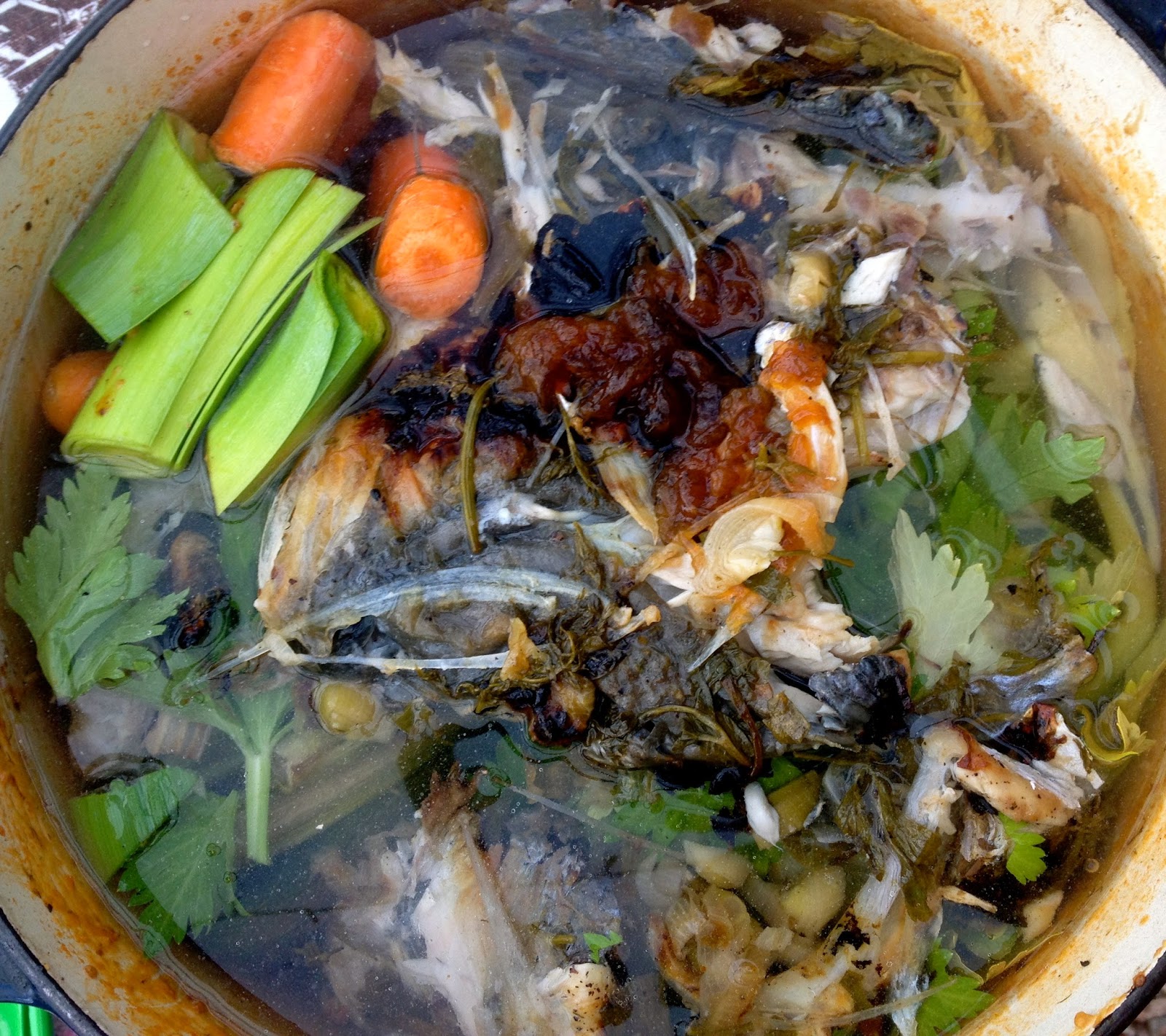
In our house, a broth normally involves lots of different veggies and herbs from our garden and the gardens of our friends (onion, garlic, parsley, carrots, celery, sweet potato just as a start), and some chicken bits. The chicken bits may include feet and/or necks,  a carcass or 2, and/or some bones leftover from a roast. Then we simmer it all with a splash of apple cider vinegar for a really long time - 24 hours at a minimum - sometimes on the fire, sometimes on the gas, topping up the water if needed. We then strain it off. The liquid gold that results from this process (seriously! It's gold!) is then either drunk, straight up, like an old-fashioned health brew, or used as a base for soup, miso, risotto (we've recently been experimenting with grains like spelt and barley in our risottos, which we're loving) or whatever else needs a bit of liquid goodness.

Now obviously we're not the first people to be in love with bone broth as super-healing elixir: this kind of caper has been going on for yonks, in all kinds of cultures, all over the world. The thing that amazes us is that it's not more popular and prevalent. Seriously - it's home-made medicine yo! And it tastes super-great! And it's cheap! And it uses up bits of stuff that might otherwise just get chucked out or composted!! And if you don't believe me, my exceedingly clever and nutritionally wise friend Genna has written about it on her beautiful blog, How Do You Like Them Green Apples? and there's also more information - historical, nutritional, and instructional - on the Nourished Kitchen blog. Look at it - it's good for you.

While chickens, for obvious reasons, are forming the basis for the vast majority of the broth action around here, we're also enjoying pastured beef bone broth (from our friends at Symphony Farm) and some pretty freakin' awesome fish broth, courtesy of some of our successful fisher-friends. My personal fave for the fish broth is to just have a big bowl of it served with a ton of kimchi. Cannot. Go. Wrong.

Fish broth on the go, utilising the remnants of a massive salmon that Pearl's dad caught for us, which we baked with some dill and garlic and shallots.
And if you don't have a near-endless supply of chicken bits at your disposal, you can always do a 'freezer-bag broth', which is the way we used to do things. Basically, whenever you chop or peel a carrot/leek/sweet potato/onion/whatever, instead of composting the bits, you put them into a dedicated bag or container that lives in your freezer. Similarly, when you roast a chook, or have a BBQ or whatever, chuck your bones in there too. When the bag is full, dump the lot into a big pot with some peppercorns and bay leaves, cover with water, and simmer away!

I've just realised that this post might sound kind of bossy. I don't mean to be bossy - I'm just excited. And I'm also feeling all inspired because of the book I started last night, called Independence Days, which is all about reclaiming food production (amongst other things). So think of my ranting less as bossing and more as a call to arms - let's start with some broth, shall we??

Saturday, April 12, 2014

Fat Hens

As many of you will know, we have a little 'commercial' pastured poultry enterprise going on here on our little farm. I say 'commercial', rather than commercial, because any kind of economics-minded person would look at our set up and say it's not 'worth' it, 'commercially'. Perhaps true, if you're of that ilk, but for us, there's a lot more going on here than making a profit. Just as well, probably, cuz the profits just ain't that big... 

Luckily for us our chicken enterprise is rewarding and valuable for other reasons.
1. We're doing something we believe in, ethically, socially and economically: We treat our chickens and our land with respect, we feed our community good quality food at an affordable price, and we run our business in a way that is sustainable for us, for our community and the Earth.
2. We're contributing to the development of a local food system that is resilient.
3. We're doing something that allows us to spend time on our land, with each other, outside, which is (most of the time) really enjoyable. This one's kind of priceless as far as I'm concerned...
4. We're involving our kids in a business that is ethical and sustainable, teaching them that it's good to work (hard) for what you believe in, and that earning heaps of money isn't everything.
5. Our chickens are delicious!
These chickens are about to tuck into some fresh-cut fat hen
With all that said, though, it's not like we don't care about making a profit. Doing all the hard work (sometimes it's really really hard!!!) of pasture raising chickens and then selling them for no profit is just beyond our altruism levels. For this reason, we're working on ways to cut down on our input costs, by trying to grow as much food as we can for our chickens on farm. This, happily, also has positive environmental impacts for our business: the more food we grow, the less transportation (read: fossil fuels) is required to get the chookie's food into their beaks.
This chicken is eating some rocket
Obviously the biggest factor here is that we pasture raise our chickens, so they eat a crap-load of grass, seeds, bugs and snails that are just right there for the taking, meaning that unlike shed chickens, we don't import 100% of their food from someone else's farm. We don't do anything to cultivate our pasture, other than the odd slashing. It's naturally really diverse, with a mixture of annuals and perennials, summer and winter dominant crops, so there's not really a down-time. But the chickens do still need grain.
This chicken is eating a snail
Our grand plan was to pasture crop an acre of triticale this Autumn, but ye olde cancer diagnosis and recent mastectomy threw a spanner in those works, and we're going to have to wait til next year. Call us piss-weak, but experimental grain growing was just a little beyond our capacity at this time.
These chickens are eating microlaena seeds, and are about to stumble upon some sunflower seeds.
Chickens, in the mean time, are being satisfied with other grown-on-farm delicacies like gone-to-seed rocket, lettuce, spinach et al, and some sunflowers we kind of accidentally grew over the summer by way of spilt seeds that were left all over the paddocks by the chickens. Bonus! Next summer we might actually do it on purpose!
These chickens are enjoying some really big sunflower heads
The other big on-farm chook-feeder has been our extensive crop of fat hen, which we also pretty much grew accidentally. We've written about fat hen before, because we love it, but here's a super-cool little blurb from survival.org that really sums things up:

"Chenopodium album, Fat Hen, is probably named because chickens get fat from eating it. It has been used as a vegetable in Europe since prehistoric times. It grows faster and absorbs nutrients more efficiently than any crop, and can grow in almost anything. That plus the fact that it is also a rich source of nutrients makes it one of the most useful plants that there is."

OK!

It's proved to be an absolute boon for our chickens. They love it, and we take them bunches and bunches of it every day all through the growing season. 
This is a close-up photo of fat hen flower heads. The seeds are the little black dots
Now that it's going to seed, we're harvesting the seeds and adding them to the chickens' daily health porridge, which consists of wheat bran, ground sunflower and linseeds, apple cider vinegar, and kelp meal, and now, fat hen seeds. 
This lady-farmer has just mixed up a batch of super-health-chicken porridge, which she is about to deliver to her chickens.
They are digging it!

Saturday, February 1, 2014

Life and Death

Born again farm cat, watching over her veggies
A few months back, my fellow chicken grower/abattoir worker and general farming mentor Mandy said to me "Farming's really all about loss". This seemed like a dire assessment at the time, but I figured she'd know - she and her lovely family run Symphony Farm, which is an amazing, integrated, certified organic property in Tilba. She's been farming her whole life, as has her husband and all their (now grown up) kids.

The last week, we've learned first hand a little bit about what she meant. It's not so much that farming is all about loss - see our last blog post, for an example of the joys - more that your farming life is kind of defined and ruled by loss and the avoidance of it.

A week and a half ago, our then-week-old chicks started dying. They basically haven't stopped. After talking to experienced chicken farmers and hearing the findings of my mum's thorough research, we thought we'd narrowed down the cause of the fatalities to the new rawbale brooder house. Turns out there is a condition affecting young chicks that can be caused by spores that grow in strawbales. We decided this was our problem, so dismantled the brooder house (a humbling experience) and hurriedly built a new brooder out of corrugated iron. The deaths slowed, but still haven't stopped, despite the 2-6 day incubation period having passed.

We've also had days and days of hot weather, which gives us the challenge of keeping the chicks within a safe temperature range - lots of wet towels and water dishes around the place is pretty much the best we can do.

We know some other people who got chicks from the same batch from the hatchery, and they are also having problems. It's not so much that there is a single lot of symptoms affecting all the sick chicks, more just that the chicks seem to be very weak, not resilient, and lacking an appetite. It's upsetting, to be sure, and frustrating because we have no idea how to help the situation and make it stop. All we can do is take extra care (we've set up a little hospital inside our house for the ailing chicks, and have had some success with recoveries) and make sure the chicks are comfortable and eating well - kale, kelp meal, brewers yeast, and apple cider vinegar are all on the menu in addition to their normal rations.

In this midst of all this, we had another, more devastating decline in one of our animals. My beloved cat, Bunn, who has been my cat companion for my whole adult life, went from sleeping a lot (kind of OK given she's an old lady), to not being able to walk, to barely breathing in the space of about 24 hours. After sitting up with her all night, patting her and crying, I made the agonising decision to have her euthanased. We are all very sad. She's been such a constant in our lives, from inner-city alley cat, moving through all my many and varied share houses in the Inner West of Sydney, to born-again farm cat traipsing through the paddocks and enjoying the strawbale windowsills at Autumn Farm. I'm glad that this is her final resting place. She will be missed.
Bunn's last photo - helping the kids with their camp fire, where they were busy cooking a "buffalo leg"
Red oak lettuces were a particular favourite resting spot
And cookbooks in the sun
The night we buried Bunn, our dog Sock - Mr A1 Fox Chaser here at Autumn Farm - was helping me with the chicken rounds when he ran out onto the road and was hit by a car. He broke his tail, and also his pelvis in 3 places. Euthanasia was also on the cards for him, until the vet reconsidered his age. She said she's seen good recoveries from breaks much worse than his, given 12 weeks of cage rest. So more nursing our very sore and sorry pup, who is to be confined in his cage for the next few months dining on vegetable and chicken broth, and chicken hearts and livers.
Sad Mr Sock in his convalescent cage
It's been a sobering, humbling experience for us. We are still so grateful for everything we have, and we know how minor our losses are in the scheme of what some people experience in their lives and on their farms. 

And we do have some beautiful things to be grateful for in spite of the sadness. 8 baby ducklings, abandoned by their mother the day they hatched are now living with us (in our tiny house during the night, and in our veggie garden during the day) after being brought back from near-death with the help of a hot water bottle. 
The ducklings by day - today they've been feasting on lettuce and basil
The ducklings by night, with their cozy hot water bottle 'mummy'
They're cute little things, and a timely reminder that the vagaries of life on a farm aren't all bad, and that life and death are just all part of the grand scheme.

Monday, January 20, 2014

Autumn Farm in 2014

In my last post I mentioned that we had been working on a new rawbale chicken brooder house. The reason for this is that this year at Autumn Farm we're hoping to slowly increase the number of chickens we're growing for our community. 

Last year's chicken farming was a bit of an experiment, to see how we liked it, and how well it fit into the community's food needs/desires. Turns out it was a perfect fit on all fronts: We're sold on the farming thing, we're sold on being part of a local, co-operatively-run abattoir (I'm the new chairwoman!), we're sold on feeding our community locally and ethically produced whole food, and local peeps seem happy with Autumn Farm chicken being a regular part of their diet. Pearl was even interviewed as one of the 'Heroes of 2013' by the local ABC radio! Seriously, we were so proud of this, not least of all because of the other awesome people they picked out.

So yeah, we're going to grow a little. Not heaps - we don't want to overwhelm ourselves, and we don't want to over-burden our land: the aim of the game's regeneration, not overgrazing yo! We're just going to cautiously and slowly seek the balance between demand and what we can happily achieve. 

Step one in this journey was constructing a new brooder house. The old brooder house looked alright, but it was way too small and not that easy to work with. It had no insulation, and we found that the chicks had grown out of it by about 2 weeks. As we head into winter, they're going to need to be in the brooder for around 3 weeks, so we knew we had to make something bigger and better to keep those chickies safe and warm.
Day 1 inside the brooder house - it was HOT! So I added a paella-pan chick wading pool for them to drink out of while also cooling their tootsies. Newspaper is laid on the ground for the first couple of days so they can easily find their food and grit, which we scatter on the paper. Though as you can see, there are quite a few chicks already in the feeder, where they will probably stay for the rest of their days. Those little guys sure like to eat...

Being as we are super-keen on the strawbale, we decided to have a go at a rawbale (as in, unrendered) brooder house. The top of the bales are protected from rain by the roof, and the sides perform a bit like thatch, shedding any rain that hits the sides without allowing it to penetrate the bale. We're anticipating the house will last us a couple of years. When it starts to deteriorate, we'll dismantle it and use it as garden mulch. It's 2 courses of bales high (laid on edge), with a panelled recycled tin and laserlite roof, which we can take apart and tilt up as needed for ventilation and temperature control. There's a gas-powered brooder lamp inside to keep the chickies warm. The bales are pinned at the corners with star pickets hammered through the bales and into the ground, and the whole thing is wrapped in chicken wire. So far, it's been great!
A typical morning inside the brooder house. Yep. They're cute.

The chicks seem very happy in their new, spacious home, though they're still happy for some outside adventuring, which is a relief. It's important that they get a taste for grass/weeds/bugs/dirt as soon as possible, so they don't baulk at the prospect of eating heaps of greenery when they're moved out to pasture full time.
Autumn Farm chicks, 4 days old, venturing from their rawbale brooder house for the first time
In another week, they'll be moving into their new and improved moveable pasture house, which is moved every day to make sure they have fresh bedding. These houses are enclosed in electric mesh (the total run is 100 square metres for 130 chooks - a tad better than their 'free range' counterparts, who are currently enjoying about an A4 page per chook of dirt/poo inside a shed), which is moved every 3 days, so they have fresh green pick, and to make sure they don't over-excavate our land in their quest for fresh dust-baths.

It's a labour-intensive way to farm chickens, there's no doubt about it. And there were times (like after spending an hour and a half carrying the chickens to bed one night when they couldn't find the door to their newly-moved house) when I could definitely see the benefits to raising chickens conventional-style, in a shed. But the rest of the time, as we watched them on the grass, hanging out, doing chicken stuff, foraging, flapping etc, and then when we tasted them, we knew that labour-intensive pasture-raising is THE ONLY WAY TO GO.

Which is why we're doing it some more.