Showing posts with label sustainable eating. Show all posts

Saturday, November 1, 2014

Autumn Farm Chook School

It's been a little over a year now since the first Autumn Farm pasture raised chickens graced the dinner tables of the Bega Valley.

In the last 15 months or so we have learned an INSANE amount, including, but definitely not limited to, 'Dogs are way better than electric mesh fencing' and 'How to run a farm single-handedly while your partner suffers through cancer treatment'. While the learning definitely isn't over (though hopefully we're done with that last lesson), I feel like we've got a good handle on things and we're now pretty comfortable with our operation and all it entails.

A big part of our Autumn Farm vision has been education: educating people about food systems, educating people about sustainable agriculture, educating people about good food and nutrition. It's awesome to be able to share knowledge with people, and to empower people to make positive changes in their relationship with the food they eat. We love love LOVE answering questions and sharing information, hosting farm tours and taking people through the abattoir.
Pearl talking to the group of Making a Buck from a Beetroot course, run by Bega Tafe.

We also get lots of inquiries from people who are interested in our chicken farming methods, which is why we're looking to run some 'chook school' tours from around April next year.

At this stage (we're still planning) chook school will probably consist of a day (6 hours?) at Autumn Farm, where we'll take you through all the components of our chicken system from managing the day old chicks, to growing the chickens, to slaughtering, to legal requirements, and marketing. And a big local lunch to boot!

We're pretty excited,  because we love growing chickens, and we think other people should grow chickens too. It's an awesome way to improve your pasture, make a small income from even a small acreage (we only have 7 acres) and feed your community. 
In the meantime, though, I'm going to be posting some little videos about our system, and about the way we run things.

And here's the first video! This one is called 'Day old chicks in the brooder house', and there will be more coming! So if you're interested in growing chickens, or you know someone who might be interested, please forward this on to them, and/or let them know about chook school.

We're looking forward to seeing some of you at Autumn Farm Chook School next year!

Tuesday, October 28, 2014

A day

Today was an exceptionally average day. I don't mean average in the way that it's often used to mean "not great" (quite the opposite in fact) but in the sense that today was a day like so many of our days here on the farm. When I think of today, I feel peaceful and full of joy.

Lots of people - friends, family, and strangers alike - often comment on how hard our life seems. It's true that we do forego many of the creature comforts most people in the west take for granted, like internal plumbing, for example. But these 'sacrifices', for us, generally have a flip side, like experiencing the surprising and immense joy of things like bathing and doing the dishes outside. It's also true that many of the things we do take for granted, like carrying 20kg barrels of water and bags of feed over several hundred metres, several times a day, may seem a lot like hard work, but the work keeps us strong, and means we don't have to go to a gym to get our daily exercise.

So what does an exceptionally average day on Autumn Farm look like?

Pearl, Oski and I rose at around 6.30 (a little later than usual) and set to work tending to the animals - letting the chickens out, letting the dogs off, making sure everyone has food and water. It was an overcast morning, but we could see the sun trying to bust through the clouds. We cheered it on, for the chickens' sake - they've had enough dampness these last few days.

When we returned to the homestead, Olive had woken up and was reading in bed in the loft. We made tea and hot water with lemon, and the kids had spelt pikelets with the last of the preserved blackberries from last summer for their breakfast. We packed lunchboxes (leftover veggie dumplings, more pikelets and fruit) and Pearl headed off for her day's work cooking at a cafe in town.

The kids played wild games with the dogs as I did the dishes, and then Olive got the bus to school.

With the 'morning rush' over and done with, Oski and I set to work on the important business of sewing  and harvesting and preparing food, which took up the rest of the day.

I made 3 skirts for the Mumbulla spring fair, and a bolero for my friend Genna (she's making me a hat as a trade!), sitting at the big table outside where we do pretty much everything, while Oski played around me, making 'jam' from some mulberries he'd picked. 
My dad came over to chop up some firewood for us, and we chatted, he played with Oski, and helped me to move the chicken houses and top up food and water before heading off.
Around lunch time, Oski and I harvested 2 massive bowls of broad beans. We sat together at the table and shelled them, then blended half of them with garlic, olive oil, lemon juice, grated parmesan and mint to make a broad bean pesto, one of our favourite springtime treats, which will provide snacks and lunches for the next few days. The other half we reserved for our dinner. We then dined on a pretty random but delicious luncheon of broad bean pesto, leftover chicken, kimchi straight from the jar, fruit, nuts and the last of the pikelets.
Our appetites sated, we once again did the rounds of the chickens, played with the dogs, admired the new ducklings in the orchard, and tended to the 5 day old chicks in the brooder house.
A few days ago Pearl's dad had caught us a massive salmon, which was to be our dinner. Inspired by one of our favourite cookbooks, Moro East, we stuffed it with fennel, lemon and parsley, wrapped it in foil, and set it on the barbecue to cook. As the most delicious smells started wafting from the cooking fish, we headed into the orchard to take out the compost, admire the babies again, and collect many many eggs.

The afternoon is maybe my favourite time of the day for wandering and looking, and it was especially beautiful today given the weird mix of sunshine, big black clouds and enormous, intermittent raindrops.

And then Pearl and Olive came home, and much catching-up and storytelling, pesto-tasting, kissing and cuddling ensued. Final dinner preparations (cous cous with broad beans and yoghurt dressing and a simple cabbage coleslaw) were made as children played and water was delivered to the chickens.
Dinner was, as always, chaotic and rowdy and delicious. We're all pretty exhausted by this time of the day, but it's also a joyful catch-up time, especially on days like today where we've each been doing our own things. Meal times are possibly the times we feel most rich, because we feast so well on a bounty of home-made and home-grown goodness that is almost ridiculous, looking out over our beautiful valley, listening to the birds and, tonight, watching the kangaroos. It's hard not to feel blessed when your meal-times look like that and home made chicken liver pâté and fresh broad bean pesto are your go-to staples.

After dinner was Oski's 'pretend birthday', complete with a sand cake and pass the parcel presents.

The light was starting to fade as we got Oski ready for bed, and he and I retired to the loft for stories and cuddles and sleep, while Pearl and Olive locked up all the chickens and delivered the dogs to their night-time chook-guarding posts.

In all, I'd say that from wake-up time to sleep time, we spent a total of about 15 minutes inside the house. It was a lovely, average day, and I wouldn't swap the hard work for all the creature comforts in the world.

How was your day?

Saturday, October 25, 2014

So we barter

When I was young and idealistic I entertained various fantasies of being self-sufficient: Building my own house, growing my own food, and basically being a hermit. No environmental footprint for me.
Now that I'm older (though still idealistic) my feelings about self-sufficiency have changed. For starters, I now have a family who don't necessarily share my hermit plans. But more significantly, now that we've really and whole-heartedly embarked upon a life where we are attempting to provide for ourselves in as many ways as we possibly can, we've realised how bloody hard it would be to actually produce everything you need by your own hands. Not to say that kind of life wouldn't be rewarding - I'm sure it would - but my feelings about 'how to save the world' have ripened a bit now, and my ideology has ultimately found a home in community-building.

What do I mean by that? Well, I mean talking to people. I mean valuing the work people do. I mean supporting people who are creating and growing things in our local area. I mean sharing and providing food for people. I mean sharing knowledge and information and encouraging people. And maybe more than anything else, I mean swapping and bartering as much as possible. 

One thing that hasn't changed for me since those heady early days of ideological veganism and Grass Roots idolatry, is my belief that money is pretty much the root of all evil. Unfortunately for us, (and even more unfortunately for the billions of impoverished and enslaved peoples around the world) we live under capitalism, which means that, short of the aforementioned hermit lifestyle, you kinda need to participate, at least a little bit, in the money economy. So what can you do about it? Well, you can be super-hyper vigilant about who you give your money to. Yes folks, it's true that under capitalism, one of your most powerful weapons is what you do and do not choose to spend your money on. Ask yourself: What kinds of things is this purchase supporting? Child labour? Slave labour? Crapy living conditions for factory workers? Environmental destruction? Cultural destruction? If you're answering yes to any of these questions, find an alternative, or go without.
Springvale community food swap at Linda and Paul's, down the road. What the heck kind of  shop comes with these views, cups of tea, cake and friendly advice about gardening and craft???
While that may seem like a kind of crazily austere or strict regime to adhere to, let me tell you that it's actually a ton of fun, because in the process of seeking alternatives, you'll probably meet people and make connections you wouldn't otherwise make, and you will strengthen your sense of community. By supporting local people you will build resilience in your community, and you will help people find alternatives to the confines of capitalism, even if just for a little bit. Liiiiike.... you might start or participate in your local food swap, or you might think of some other way you can barter for the things you need. 

And more food swap action at Autumn Farm

You might get involved with a local food co-op, or you might start buying your produce (and I mean all of your produce) direct from the person who grew it. You might start growing more of your own, and sharing it with a neighbour!

We are pretty much massive bartering devotees these days, bartering our chickens and craft for as much as we possibly can including acupuncture, veggies, fermented foods, art therapy,  spoon carving lessons, pork, art classes, lamb, hand-knitted gloves and bread. Yes, many of these things we could produce ourselves, it's true. But you know what? Our friends Thea and Tim have the most amazing market garden. But they don't have the time and inclination to also grow chickens, just like we don't have the time or inclination (or watering prowess) to grow massive beautiful bunches of coriander and celery. So we barter.
Bartered veggie box from Thea and Tim's Fish Bone Farm
 Similarly, our friend Emily makes incredible sauerkraut,  kefir and kimchi. Yes of course we could make these for ourselves, but that's her thing, so she's really good at it, just like we're really good at growing delicious chickens. So we barter.
Bartered fermented awesomeness courtesy of Emily
I can't knit, but I really wanted a pair of rainbow-hand-dyed fingerless gloves for riding my bike in the early morning chill, and Vee really wanted one of my skirts. Her handy man Grimm knits beautiful fingerless gloves. So we barter.
Awesomely awesome riding gloves knitted by Grimm, bartered for a skirt
You see what I'm getting at? By valuing other people's skills and interests, you don't have to be super-skilled at everything yourself. And besides which, sharing the love just feels plain old awesome.

Fish Bone Farm abundance gracing the Autumn Farm kitchen. Happy days..

Saturday, October 18, 2014

The vagaries

It's been a little over a year since the first batch of 100 day old chicks arrived at Autumn Farm. It's been a massive year of learning, surviving, nourishing our community, learning some more, working hard, crying, laughing, asking ourselves (and being asked by others) "why the hell are we doing this??" and "is this really worth it??" and then realising that yes, it is what we really want to be doing with our little piece of land - feeding people.
And while it is tremendously rewarding and for me, at least, the fulfilment of a childhood dream of wanting to be a farmer, there have been times when we've had a tiny taste of the tragedy and heartbreak that also comes with trying to make a living from the land, where you're ultimately always at the mercy of Nature. Like my 3rd-generation-dairy-and-sheep-farmer neighbour said: "some days you wouldn't give it up for ten million bucks, the next day you'd give it all up for 10 cents". It is really like that.

In my mind, The Hardships of Farming always kind of took the shape of drought and flood - images of sheep lying dead in a desert-like paddock, old gnarled farmers in check shirts and akubras with their faces in their hands, murmuring desperately about being forced from their land. Or the other extreme of cattle being lifted in helicopter-slings to save them from being drowned.

We, in our extremely small-fry operation will never be vulnerable to these kinds of desperate extremes. But that doesn't mean that we don't experience a little of the rollercoaster. 
On hot days, we spray the chickens with water every hour or so, to stop them from overheating

Take the last 2 weeks. A fortnight ago, the weather was sunshiny spring. The chicks were loving it, the big chickens were loving it. Everyone was happy and healthy and growing well on the beautiful spring pasture. Pearl's and my moods (inextricably linked to the health and happiness of our chickens) were high. It was a 10 million dollar kind of a time.

And then we had a cold rainy snap. What does a cold rainy snap mean for a little pastured poultry enterprise? First of all, it means that we need to buy straw. There's no point moving the chicken houses onto wet ground, so the daily house move is replaced by houses filled daily (sometimes twice daily) with dry straw, to keep the chickens healthy, if not happy. Buying straw means our (already slim) profit margins go down, so while we love and need the rain, it's always in the back of our mind.

It means days of trudging around in raincoats at all hours of the day and night, tending to feed and water and straw, making sure the chickens are managing to stay dry. It means slipping over in the wet grass.
And, sometimes, it means death. This last cold rainy snap came at an unfortunate time for our chicks in the brooder house, who'd been happily acclimatising to the warm spring weather. They'd been born during mild weather, arrived on our farm during warm weather, and we'd been slowly lowering the heat in the brooder house in preparation for their move to pasture. So when the temperature dropped 20 degrees literally overnight, they had no preparation or resilience for cool weather and, in spite of the heat lamp in the brooder house, they piled up and crushed, out of desperation to keep warm.

The temperature, at 10 degrees, was nowhere near as cold as our winter chicks tolerated. But they were used to it. Not so these springtime chicks.
It is really sad. As the peeps at Buena Vista Farm put it, "Who'd be a farmer, eh?" (they have an excellent post with that title, and I strongly recommend you read it if you'd like to understand a little more about the human energy goes into producing your food). Those are the 10 cent days.

But now here we are in the sunshine. The chickens and chicks are all happy again. Yesterday we sold 120 chickens to some very happy local people, who hopefully feasted well last night. Today, across the Valley, people are cooking up bone broths and chicken soups. And that is what makes us keep going. But it's hard - no bones about it.


* Thank you Jay for taking beautiful photos of our chickens

Friday, September 26, 2014

Banana passionfruits are rocking our world right now

Several years ago, at Alfalfa House, our beautiful friend Jay introduced Olive and I to banana passionfruits. Jay was super-enthusiastic, having grown up eating them. I was less enthusiastic, having had a disastrous encounter with some passion pop around the age of 15.
Banana passionfruit inside. According to Oski, they're "just like little lollies!"
In spite of my passionfruit aversion, however, I could still see the appeal (most significantly that they have more pulp and are easier to eat than a normal passionfruit) and planted one about a year ago, here on Autumn Farm.

The thing went beserk.
The vine, along with a bit of fluoro pink geranium and a hardenbergia
So much so that I began to think that the weedy rootstock (which most commercially-grown passionfruits are grafted onto) had taken over. Just when I was beginning to think I had a really really tedious and enormous weeding job on my hands, some flowers appeared, and a quick Google consult confirmed that they were indeed the flowers of a banana passionfruit. Yay! The best thing about this discovery was that we had HEAPS of flowers on our vine, which we hoped would translate into HEAPS of fruit.

And they did. Right before winter.
Green banana passionfruits on a mattress spring fence in winter, getting ready for their spring flush
I couldn't quite work out how this would work. Do they just hang there, green, over the winter? Through frosts? Then ripen up when the weather warms? It seemed unlikely, but it turns out this is exactly what they did. The first glimpses of spring brought the first glimpses of yellow fruit on the vine, and we're now reaping the bounty.
Easy and delicious for kids! Oski demands one in his lunch box, always
Yes, even I am enjoying several of these little beauties every day. It seems my passionfruit aversion (and my very dramatic and vehement dislike of peanut butter) was 'cured' by chemo. When I read on the chemo side effects lists that my "taste buds might change", I was sceptical. Especially when it came to peanut butter, which I couldn't even stand being in a room with. But here I am, eating passionfruit and peanut butter like there's no tomorrow. Amazing! Delicious!

So if you're thinking of planting a passionfruit, or a climbing vine, or a shade-supplier with edible side benefits, have a go at a banana passionfruit. They're ridiculously vigorous (ours covered a 3-mattress-springs-long fence in a little over a year) and will supply you with beautiful, delicious fruit at a time of year when you might need a little break from the citrus. What more could you ask for?


Tuesday, September 16, 2014

The first days of spring, oh how we're loving you

How exciting that it's spring! Given that we've just experienced what we hope will be The Crappest Winter Ever, the springtime this year is more welcome than ever - bring on the new growth, both literal and metaphorical, I say! My hair's growing back (it feels like a little baby lamb!), we're slowly recovering our energies after the exhaustion-inducing chemo regime, and everything is looking extra sunshiny and new given the deepened gratitude we're experiencing as a result of the last 6 months or so. We've been absolutely revelling in the warm sunny days, picking early raspberries, resting, enjoying spring rains, watching our chickens loving the new shoots of grass, smiling at rosellas in the kennedia, and working working working on the garden - weeding, mulching, harvesting and spring planting yay!
We've also been...

Crocheting veggie tea cozies for lovely gardening sisters,

 Debuting new birthday frocks and devouring the goodness (mushrooms! Honey! Profiteroles! Jersey milkshakes! Crazy amounts of beautiful, bountiful veg! Fresh and smoked fish!) at the Moruya Farmers' Markets,
 Being thrilled by big digging and dreaming about another little strawbale house growing from the mud over the next couple of years,
Crocheting around jar-lid-rings to make bangles for the Mumbulla School Spring Fair,
 Eating duck egg omelettes with greens from the garden and bartered kimchi in the sunshine almost every morning, and loving our life.
How about you? How are you heralding the warmer days?

Sunday, August 31, 2014

Happy spring!

I do believe that my favourite thing about living in our tiny house is the way it makes us super aware of and in tune with the seasons. 

For most of the year, we eat our meals outside at our big hardwood table. It's beautiful, being as it is almost in our vegetable garden, and we can see what's growing, we can watch the birds and the wildlife and the changing sky.

But when the weather's cold (Bega gets cold in winter!), and darkness comes before dinner time, we retreat inside for our evening meals. This is pleasing in its own cozy way, but by the time the days lengthen and the weather warms up, we're busting to get back outside.
2 nights ago, it was warm and light enough to eat outside, so we made the transition. Just like that. And it was delightful! The kids did their thing of flitting back and forth between the cubby, trampoline and table, shovelling in mouthfuls as they passed us, as Pearl and I sat and enjoyed our dinner.
To celebrate this minor but also significant seasonal turning, I'm going to share the recipe for the dinner we had. I'm calling it Autumn Farm Fried Rice, and it's loosely based on the fried rice my mum made for us when I was growing up, though with a more seasonal, use-what-you've-got kind of ethic. It's a great meal for using up bits and pieces of veggies from your garden or the fridge, and you can adapt it in many sundry ways - go wild! Have a go! It's super delicious and nutritious, and you can make it with pretty much whatever you've got hanging around, like I said. Peas are nice, as is corn, in summer... This recipe is basically the quantities I used to make dinner for the 4 of us, with no leftovers.

First, you'll need to put your rice on to cook. We use rain-fed Australian brown rice, which is quite delicious! Cook 2 cups of rice in 4 cups of water until all the water is absorbed. Set it aside, with the lid off, so that the rice kind of dries out. Of course, if you've got it, you could use leftover rice too!

Next, make an omelette. I used 6 duck eggs, a little bit of salt and 1 shallot, chopped up. Whisk this all together, then pour into a frypan with very hot oil in it. When it's cooked through, set it aside.

In the same pan, cook 2 chicken breasts, so they're nice and crispy on the outside. Set these aside with the omelette.

Now, in a big wok, heat a few tablespoons of oil (I used sesame oil). Add a couple of tablespoons of grated or minced garlic, and the same of grated or minced ginger. If you have shallots or something like that they can also go in now. I also added 3 smallish carrots, finely diced. Just fry them for a little minute til they start to cook.

Then I added the rice! Stir it all around, and add a bit more oil if you need/want to. 

I then chucked in the omelette and the chicken, which I'd kind of torn up into small pieces, and some sunflower seeds. Almonds are also nice if you have them.

Keep stirring!

Then I doused the whole lot in tamari. I have no idea how much - just til it tasted nice.

Right before it was served, I stirred through about 3 bunches of tatsoi that were grown by our awesome friends Thea and Tim who grow the most amazing veggies around. Luckily for us, they're happy to trade awesome veg for chicken. Yeah!

And that's it! We served ours (the grown-ups) with green tomato chilli jam, which just takes it to another level of deliciousness.

Tuesday, July 22, 2014

Woohoo bone broth!

After my first dose of chemo knocked my white blood cells through the floor (like, there weren't any left..) my oncology nurse asked me if I'd had any drugs to bring them back up - apparently they'd made an impressive recovery. And you know what? No drugs were involved in the resurrection of my white blood cells, just an insane amount of bone broth. 

That's just one of the many good things about being a pastured chicken farmer - almost endless supplies of super-healthy chicken bits for making broth. I even caught myself thinking things like "Wow! What better time to be a pastured chicken farmer than when you've got cancer!". And while that's obviously a slight exaggeration (keeping Autumn Farm going through all this has been slightly arduous - just ask Pearl and the small army of 'chicken support units' who've been lending a hand) it has been great to know that I can drink as much pastured chicken broth as I like.

So what's so good about broth? And what even is broth anyway? Well, in our minds, broth is a magical liquid that's got some major goody-goodness-nutrition in it, normally involving cooking a whole bunch of the best kind of health-giving ingredients for a really long time. The long-cooking extracts the nutrients and minerals from your ingredients  (especially the bones), condenses them into the liquid, and makes them available for your body to absorb and use. According to, Jennifer McGruther, author of The Nourished Kitchen, "Homemade broth is rich in calcium, magnesium, phosphorus and other trace minerals.   The minerals in broth are easily absorbed by the body.   Bone broth even contains glucosamine and chondroiton – which are thought to help mitigate the deletorious effects of arthritis and joint pain." 

Perfect for sick people, little people, chemo-ravaged people, and even perfectly healthy normal people who need some nourishing goodness in their lives!

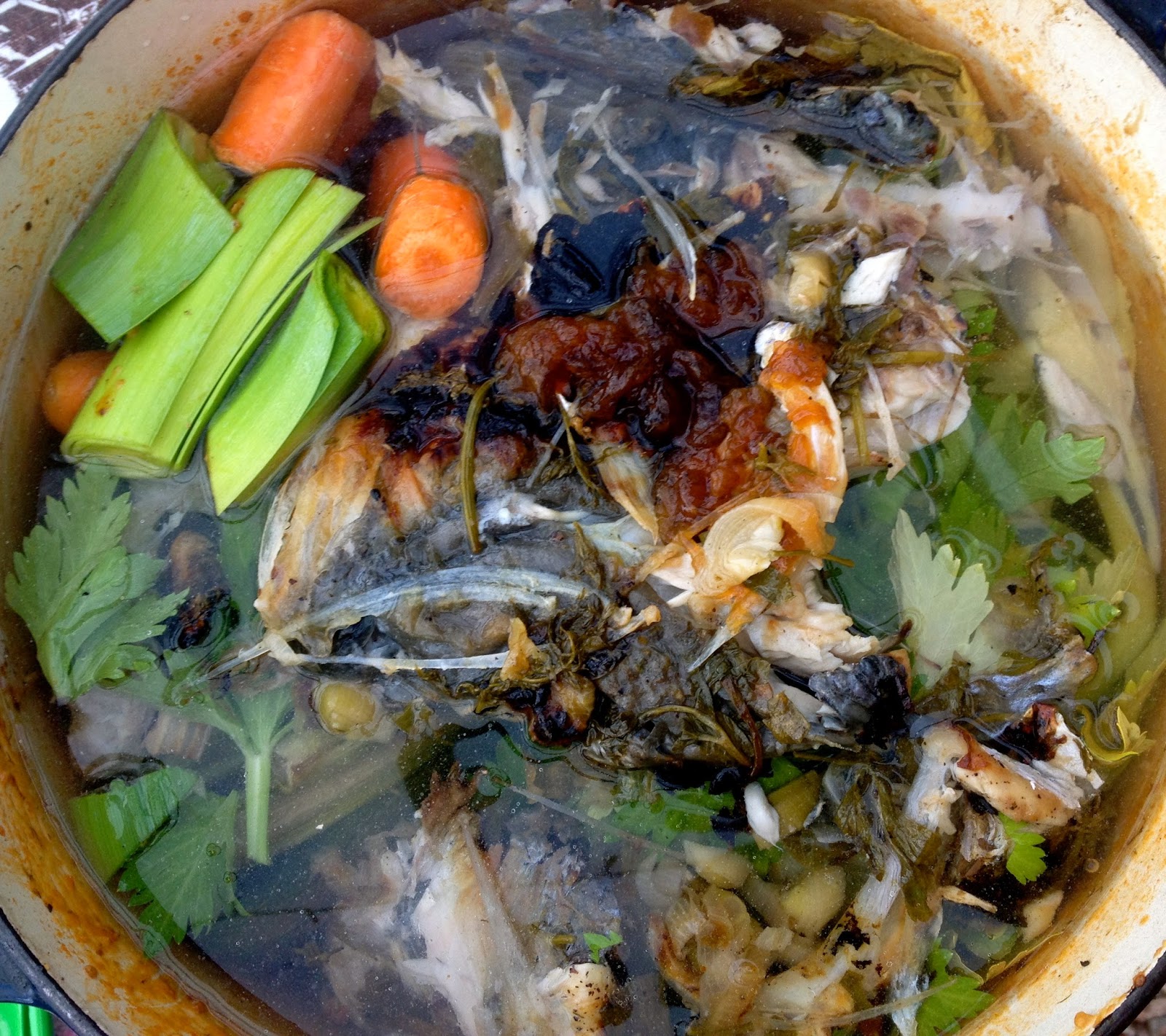
In our house, a broth normally involves lots of different veggies and herbs from our garden and the gardens of our friends (onion, garlic, parsley, carrots, celery, sweet potato just as a start), and some chicken bits. The chicken bits may include feet and/or necks,  a carcass or 2, and/or some bones leftover from a roast. Then we simmer it all with a splash of apple cider vinegar for a really long time - 24 hours at a minimum - sometimes on the fire, sometimes on the gas, topping up the water if needed. We then strain it off. The liquid gold that results from this process (seriously! It's gold!) is then either drunk, straight up, like an old-fashioned health brew, or used as a base for soup, miso, risotto (we've recently been experimenting with grains like spelt and barley in our risottos, which we're loving) or whatever else needs a bit of liquid goodness.

Now obviously we're not the first people to be in love with bone broth as super-healing elixir: this kind of caper has been going on for yonks, in all kinds of cultures, all over the world. The thing that amazes us is that it's not more popular and prevalent. Seriously - it's home-made medicine yo! And it tastes super-great! And it's cheap! And it uses up bits of stuff that might otherwise just get chucked out or composted!! And if you don't believe me, my exceedingly clever and nutritionally wise friend Genna has written about it on her beautiful blog, How Do You Like Them Green Apples? and there's also more information - historical, nutritional, and instructional - on the Nourished Kitchen blog. Look at it - it's good for you.

While chickens, for obvious reasons, are forming the basis for the vast majority of the broth action around here, we're also enjoying pastured beef bone broth (from our friends at Symphony Farm) and some pretty freakin' awesome fish broth, courtesy of some of our successful fisher-friends. My personal fave for the fish broth is to just have a big bowl of it served with a ton of kimchi. Cannot. Go. Wrong.

Fish broth on the go, utilising the remnants of a massive salmon that Pearl's dad caught for us, which we baked with some dill and garlic and shallots.
And if you don't have a near-endless supply of chicken bits at your disposal, you can always do a 'freezer-bag broth', which is the way we used to do things. Basically, whenever you chop or peel a carrot/leek/sweet potato/onion/whatever, instead of composting the bits, you put them into a dedicated bag or container that lives in your freezer. Similarly, when you roast a chook, or have a BBQ or whatever, chuck your bones in there too. When the bag is full, dump the lot into a big pot with some peppercorns and bay leaves, cover with water, and simmer away!

I've just realised that this post might sound kind of bossy. I don't mean to be bossy - I'm just excited. And I'm also feeling all inspired because of the book I started last night, called Independence Days, which is all about reclaiming food production (amongst other things). So think of my ranting less as bossing and more as a call to arms - let's start with some broth, shall we??

Saturday, April 26, 2014

An ode to the salad

One of the main things you need to come to terms with when embarking upon a community food/self-sufficiency/local food type journey, is that your ingredients need to dictate the recipe, not the other way 'round. In our culture, we're so used to being able to think about what we want for dinner, then go to a shop and buy everything we need, with no regard for season or local availability. For this reason, a lot of people don't even know what's grown when, in what part of the world.
Seasonal home-grown salad deliciousness, picked 5 minutes before it hits the table.
When you start getting interested in local food and self-sufficiency, one of the first things you learn about is eating seasonally. We've written before about the joys of seasonal eating. We love it. If you try it, I bet you'll love it too.

Of course, it means that there are, at certain times of the year, things you just can't eat. At the moment, for example, I'm pretty much busting for some broccoli and cabbage. But broccoli and cabbage aren't quite ready round these parts just yet. I've got a few more weeks' wait, but I know when the wait is over, the broccoli and cabbage is going to taste oh so sweet, not least of all because I haven't eaten any for some months.

Sometimes, because of seasonal availability, or weird in-between-season gluts or dearths, you'll have a whole bunch of something, or little tiny bits of lots of things, or strange amounts of something else, and you think - what the heck am I going to do with this!? The answer, I've found, to these kind of seasonal-eating conundrums is, invariably, soup and/or salad.
An heirloom tomato salad's gorgeousness is enough incentive for me to grow my own tomatoes.
It's really easy to make a delicious soup or stew from whatever ingredients you have to hand. All year. If you have an on-hand source of home-made stock in your freezer, even better.

Yesterday, for example, Louisa dug up a massive bowl of jerusalem artichokes, which had voluntarily grown themselves in amongst our lemon balm. With 12-hour-cooked chicken broth in the freezer, the answer to our jerusalem artichoke situation was pretty bloody self-evident, and tomorrow we shall be dining on some super-deliciousness.

Likewise for salads. I grew up eating salads consisting of iceberg lettuce, tomato and cucumber. Delicious! While I still have a massive soft spot for iceberg lettuce, I've since learned that it's nigh-on impossible to grow, so have learned to settle for much more eclectic salad ingredients, dictated, at all times, by what's in the garden or the gardens' of our friends and neighbours. 
roasted pepper , parsley and home-pickled 'caper' salad with home-made flat breads and hummous
Kale (I find curly kale best for salad), red-veined dandelion leaves, rocket (grows like a weed!), nasturtium (ditto!), borage, herbs of all kinds and a plethora of self-seeded loose-leaf lettuce varieties all make regular appearances in salads at our place, year-round. 
Mixed leaves, awaiting salad-making
Grated carrot, beetroot, garlic, and chopped tomatoes and celery, green beans, peas, cooked pumpkin and weeds like fat hen and nettle are also added, according to availability. I'm a massive fan of the grated and finely-chopped salad, because I like to have little bit of everything in every fork-ful. Makes it tasty, yo!
grated carrot and beetroot, dandelion, kale, parsley, basil, chopped almonds, sunflower seeds and feta-stuffed bell peppers, grown and made by the lovely Bev. I love the colour!
I also like to add nuts (chopped tamari almonds are a distinct fave), seeds, flowers (borage, nasturtium and calendula are my absolute favourites), olives or other preserved and pickled type things for extra tasty and extra nutrition. 
Pretty!
For dressing, I'm ever-faithful to a bit of lemon and olive oil, though I've recently been thoroughly enjoying ye olde tahini-based dressing, and sometimes a bit of a miso dressing. I'm extremely haphazard with my salad dressings, and will pretty much mix up anything that takes my fancy, with varying degrees of success. But that's the thing: When you're using good ingredients, it's pretty hard to make it taste like absolute crap.

So even if your garden's patchy, or you've brought home a somewhat random selection of ingredients from your local market, rest assured that there's a delicious and nutritious salad or soup in store. Feel free to post your favourite salad dressing recipes or soup combos in the comments. We're always up for suggestions!!

Extra added bonus of growing your own - you make friends. Anyone know what kind of frog this is?

Friday, April 18, 2014

Community food continues

It's been a  month since we started our Community Food Challenge in earnest. I'd say we're going pretty well! During the last month, in addition to challenging ourselves in the food ethics department,  we've also had some adventures in mushroom foraging, a mastectomy and some time in hospital, many many helpful visitors (bringing delicious, nutritious, local treats like oysters and foraged mushrooms), we've processed a batch of Autumn Farm chickens, and Pearl, with the help of our visitors and local helpers, has done an amazing job of maintaining the farm as I recuperate from my surgery. So yeah, it's been a busy, emotionally crazy kind of time.

In the food stakes, we've revelled in the joys of our community food endeavours, but we've also broken our own rules a few times. The culprits? Nori (the kids love it and it's REALLY good for them), raw organic cacao and coconut butter (it's delicious and has anti-oxidants in it... I know.... weeeeak...), and I believe Pearl at some point bought some discount corn thins for the kids while she was in the supermarket getting toilet paper.

I actually feel OK about these slips, and we're certainly not beating ourselves up about it. We're too busy enjoying the deliciousness and satisfaction of the vast majority of the food we're eating. Here's a little bit of what's been on our plates:

Home-made pork and fennel sausages with locally grown red cabbage and mashed potatoes, with lentils and herbs.
Home-grown eggs scrambled with home-grown leafies and herbs, sliced, just-picked tomato and foraged mushies courtesy of our mate Liz.
Eggs poached in home-grown tomato stew with herbs and local jersey feta.
Eggs poached in home-grown tomato stew with herbs and feta
The kids, Gab and I also had a rather successful mushrooming haul a couple of days before I went into hospital (much more successful, but no less fun, than our mushrooming ventures of last Autumn). It was a drizzly saturday when we all set off for the pines, to see if we could nab ourselves some pine mushrooms. We only found 2 of the pine mushrooms (Gab had them with poached eggs on toast), but we did find 2 baking trays full of slippery jacks!


I've never had slippery jacks before, and some of the accounts I read online weren't too enticing. One writer even went so far as to write that given the amount of time it takes to prepare them for eating (you have to peel off the top slime, and some people recommend peeling of the pores from the underside - I did both), and their kind of bland, slimy texture, they're not really worth the effort. Here, I have to disagree. I reckon they maybe just weren't cooking them to their best effect.

A little more research revealed that this kind of mushroom isn't the kind you just fry up and eat by the truckload like some other kinds. It's most commonly revered by Eastern Europeans, who like to cook them up into a stew. So Pearl fried ours up with some home-cured bacon, home-grown eschallots and garlic, and then used that as a base for a pearl barley, beef bone broth and rosemary stew. Nothing short of amazing and definitely, beyond a shadow of a doubt worth the peeling. Not to mention the fun we had picking them, in a beautiful setting, with beautiful people, which was worth all the work just by itself!
Happy kids and their mushroom haul

The bone broth we used in the stew was something that had been cooked up to assist with my healing after surgery. A few days before I went into hospital for my mastectomy, we started cooking up a bone-broth of certified organic pasture-raised beef bones, courtesy of our friends the Thompsons at Symphony Farm. We cooked it over the fire for about 12 hours, then again on the stove for maybe another 12, to draw out all the super-goodness. While I was in hospital, Pearl continued the brew, adding veggies and garlic and tons and tons of kale. It. Was. Delicious. And nutritious. Luckily for me I was allowed to come home the day after my surgery, so I was able to enjoy this as my convalescing food for the days after my surgery, as opposed to the nutritionally devoid and most certainly not local (processed, packaged and frozen in Goulburn, in fact) hospital food. Perfect.
And I'm pretty sure that the setting for the cooking of the bone broth also contributed to its awesomeness. I was also really glad to be home, healing in my own place, with my loved ones nearby.

Have you had any fun, satisfying, delicious community food adventures lately?

Saturday, April 12, 2014

Fat Hens

As many of you will know, we have a little 'commercial' pastured poultry enterprise going on here on our little farm. I say 'commercial', rather than commercial, because any kind of economics-minded person would look at our set up and say it's not 'worth' it, 'commercially'. Perhaps true, if you're of that ilk, but for us, there's a lot more going on here than making a profit. Just as well, probably, cuz the profits just ain't that big... 

Luckily for us our chicken enterprise is rewarding and valuable for other reasons.
1. We're doing something we believe in, ethically, socially and economically: We treat our chickens and our land with respect, we feed our community good quality food at an affordable price, and we run our business in a way that is sustainable for us, for our community and the Earth.
2. We're contributing to the development of a local food system that is resilient.
3. We're doing something that allows us to spend time on our land, with each other, outside, which is (most of the time) really enjoyable. This one's kind of priceless as far as I'm concerned...
4. We're involving our kids in a business that is ethical and sustainable, teaching them that it's good to work (hard) for what you believe in, and that earning heaps of money isn't everything.
5. Our chickens are delicious!
These chickens are about to tuck into some fresh-cut fat hen
With all that said, though, it's not like we don't care about making a profit. Doing all the hard work (sometimes it's really really hard!!!) of pasture raising chickens and then selling them for no profit is just beyond our altruism levels. For this reason, we're working on ways to cut down on our input costs, by trying to grow as much food as we can for our chickens on farm. This, happily, also has positive environmental impacts for our business: the more food we grow, the less transportation (read: fossil fuels) is required to get the chookie's food into their beaks.
This chicken is eating some rocket
Obviously the biggest factor here is that we pasture raise our chickens, so they eat a crap-load of grass, seeds, bugs and snails that are just right there for the taking, meaning that unlike shed chickens, we don't import 100% of their food from someone else's farm. We don't do anything to cultivate our pasture, other than the odd slashing. It's naturally really diverse, with a mixture of annuals and perennials, summer and winter dominant crops, so there's not really a down-time. But the chickens do still need grain.
This chicken is eating a snail
Our grand plan was to pasture crop an acre of triticale this Autumn, but ye olde cancer diagnosis and recent mastectomy threw a spanner in those works, and we're going to have to wait til next year. Call us piss-weak, but experimental grain growing was just a little beyond our capacity at this time.
These chickens are eating microlaena seeds, and are about to stumble upon some sunflower seeds.
Chickens, in the mean time, are being satisfied with other grown-on-farm delicacies like gone-to-seed rocket, lettuce, spinach et al, and some sunflowers we kind of accidentally grew over the summer by way of spilt seeds that were left all over the paddocks by the chickens. Bonus! Next summer we might actually do it on purpose!
These chickens are enjoying some really big sunflower heads
The other big on-farm chook-feeder has been our extensive crop of fat hen, which we also pretty much grew accidentally. We've written about fat hen before, because we love it, but here's a super-cool little blurb from survival.org that really sums things up:

"Chenopodium album, Fat Hen, is probably named because chickens get fat from eating it. It has been used as a vegetable in Europe since prehistoric times. It grows faster and absorbs nutrients more efficiently than any crop, and can grow in almost anything. That plus the fact that it is also a rich source of nutrients makes it one of the most useful plants that there is."

OK!

It's proved to be an absolute boon for our chickens. They love it, and we take them bunches and bunches of it every day all through the growing season. 
This is a close-up photo of fat hen flower heads. The seeds are the little black dots
Now that it's going to seed, we're harvesting the seeds and adding them to the chickens' daily health porridge, which consists of wheat bran, ground sunflower and linseeds, apple cider vinegar, and kelp meal, and now, fat hen seeds. 
This lady-farmer has just mixed up a batch of super-health-chicken porridge, which she is about to deliver to her chickens.
They are digging it!