Showing posts with label garden design. Show all posts

Sunday, November 11, 2012

The garden grows

We've been lucky the last couple of weeks: we've had a reasonable amount of rain. Not the massive dump kind that fills your water tank, but the slow and steady kind that doesn't run off, but sinks right in. The kind that, when you're not looking, makes your veggie plants double in size seemingly overnight. The days are warming up, too so everything's absolutely alive, and doing what we planted it to do - grow us some food.
Cabbages hearting up and salad greens going beserk
Every day we stroll around our little kitchen garden, taking in the sights and sounds and smells. Well, actually we kind of have to since our house is at one end of it and our dunny is at the other, so we have several enforced garden strolls per day, which means we can weed, pick off snails and slugs and caterpillars, monitor growth and check for baby tomatoes/zucchinis etc. It is such a joy to have the garden so close by. Those permaculturists are really onto something right? Zone 1 (having all the things you need to see and interact with every day) definitely makes sense when you read about it in books, but it really really definitely makes sense when you're living it. We basically eat dinner in our veggie patch, which means that we can see it and watch it and truly observe and interact with it, in the way we rightfully should. We're loving it.
It's called 'interplanting', and it's going beserk
We're also pretty much in love with our zone 2, as well - the things you need to see kind of regularly but not necessarily every day. That, for us, is our bee/duck/orchard area, which is between our house and the road. It's reached by the ever-impressive and gorgeous sleeper-stairs built for us by beloveds peps, Genn and Jeff, and while we do go up there very day to hang out with the ducks, let them out in the morning and put them to bed at night, and generally monitor the state of things and watch out for nasties like peach leaf curl, we don't have to walk through it every time we need to wee.

The ducks free-range in the day, coming to visit us and patrol the veggies for snails and clean up after the kids, but mostly stay close to the dam. Egg-laying location has become a mystery, however. The down-side to the roaming duck. Apparently you're supposed to keep them in their house until they lay for the day, then let them out to range, but sometimes we just can't wait. And it's oh so cute to see them all waddling out together all in a line!
The king and queens of zone 2 poultry division heading out for the day
Like I said - we'd read about the zone bizzo in about a million permaculture books, and had always been a bit "yeah yeah" about it, never having really had the opportunity to put it into place. Our last house, for example, only had 1 (kind of) sunny spot, so we were forced to have our veggie patch on the street verge and 'car port' area, which was about 60 big sandstone steps away from our house. While we did pass our veggies every day while leaving or coming home, we were inevitably rucking to get a train/carrying groceries or kids/basically focused on something else. Not so now (though we are still frequently carrying our little Oski-boy). Now we have the time to take it all in. To meander the paths. To pick, and weed and mulch and hill up potatoes, just as part of our day to day life. I can do it and still have a conversation with Pearl while she's cooking the dinner, and she can do it while I'm sewing at the table. Last night, I did it while Pearl and the kids were in the fire bath. We chatted and joked and planned and plotted. It was gorgeous.
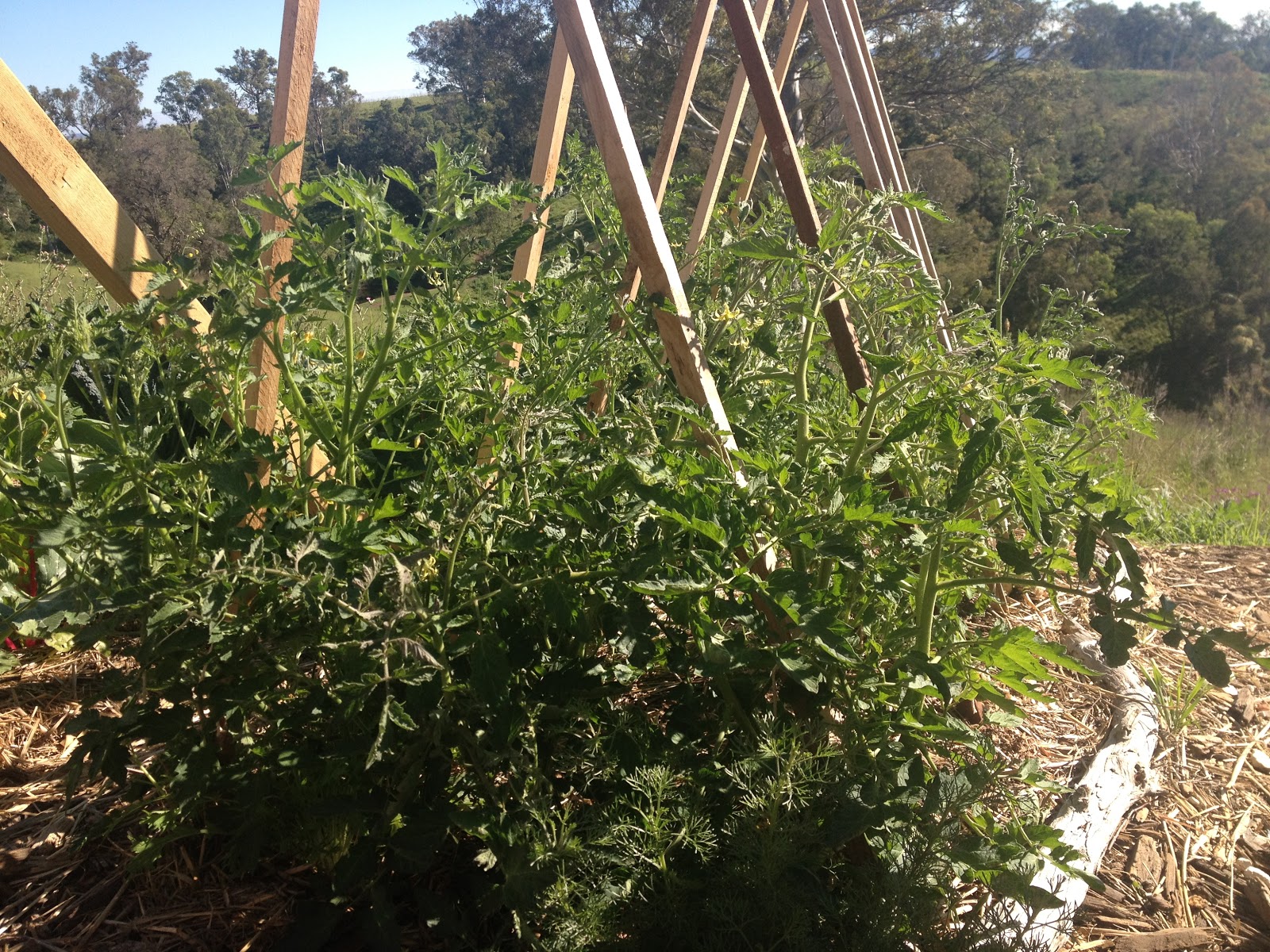
Heritage tomatoes go beserk
The moral of the story? Put your veggie garden as close as possible to the centre of your life. Our veggie garden, in the middle of our kitchen/bathroom/dining room is giving us more joy than we ever could have imagined. Every day.


Tuesday, September 25, 2012

Aahh the garden.. (and profound gestures of love)

There's been some sickness in our tiny strawbale of late. Weeks of it. The sickness has primarily been located within the uber-productive Annie. In fact you could say she has been in the grip of a full immune meltdown. I'll spare you the details. But it has meant that things have been moving slowly around here of late. Though not as slowly as you might imagine, given Annie's penchant for productivity... and so despite the sick we have been happily moving into Spring. It's true, our house is not finished, the exterior walls call at us each day asking for more lime render but we ignore them to focus on the garden. 


Ah the garden... we have been quite thrilled to observe the micro-climate we seem to possess on this here side of hill. While the lower land surrounding us gets all frosted up overnight, our top of slope positions remains remarkably frost free. This has allowed us to embark on Spring/Summer planting with little fear of frost damage to our delicate seedlings. Many people we have spoken to in the Bega valley have told us they don't plant anything out until November as it is not until this time that they experience their last frost. And so we have found ourselves exhaling with excitement and embarking on the joy of garden creation. 

This garden we are creating is our first in a place that is actually our own. I think this adds to our excitement as it is more of a forever project rather than a temporary response to a desire for growing one's food. It has allowed us to plant our first swathe of orchard and berry canes and asparagus beds and to start planning olive and pomegranate groves and a temperate food forest system. Oh but I am getting ahead of myself. Though this getting ahead of oneselves is something we seem to do each day as we traipse across our hill imagining the fruity, nutty abundance it will one day contain. 


Our first little orchard has been planted in the contour that carries water down to our (soon to be) duck dam. Unfortunately the slopeyness of our block will slow down our food tree planting a little bit on account of the fact that plonking fruit trees into the side of a hill without a swale or some kind of water slowing/catching earth manoeuvring is just silly. However swale building is either extremely labour intensive or else expensive. Further earth works are on our list of things to do when we have more money. For now, we content ourselves with nurturing our first twenty-something trees. We have four apple varieties - Cox Pippin, Sturmin Pippin, Pomme de Neige, Pink Lady, a few different pears - Corella, Williams, Nijiseiki Nashi, two Apricots and two Nectarines, some Plums - Sugar plum, Santa Rosa, Greengage, D'Agen, three peaches - Golden Queen, Anzac and Elberta, a couple of figs - Black Genoa and White Genoa and a couple of quinces - Smyrna and Pinepapple. Oh yes and two mulberries - the white mulberry 'Shatoot' and 'Hicks Fancy'. We got most of the trees as bare rooted stock so it felt like we were just purchasing sticks on massive root stock. We were relieved and excited when we first noticed the green buds appearing towards the end of winter, then the blossoms were an added bonus. Recently I've noticed no less than twelve teeny tiny peaches on the Anzac peach. We've been mulching with straw and Azolla, watering with worm juice, planting comfrey around each tree and trying to keep the damn kikuyu away from the burgeoning trees. Kikuyu! Whoever thought that was a good idea?! Soon we will have some fencing and our ducks keeping busy in the orchard so our our orchard maintenance will be made a little easier.

thyme growing amidst the sleepers

We've also been busy out the front of our little house with a mattock, broad fork, bags of collected cow manure, azolla and straw mulch as we make our zone 1 vegetable and herb garden start to happen. It's been so good to refer back to our favourite ladies of permaculture - Rosemary Morrow and Linda Woodrow as we've been planning what and how we plant. We've revelled in rediscovering these wonderful and practical writers on permaculture and felt happy in how much more illuminating it is to read something in the context of creation. We've also enjoyed mulling over the disjuncture between the planned semi-formality of a permaculture approach and the laissez faire approach espoused by Jackie French. Annie enjoyed re-reading 'The Wilderness Garden' while lying sick on the couch. And truth be told, she would love a crazy feral garden like that suggested by Jackie. Me, not so much. In a gesture of love she built a tomato trellis from some lovely hardwood stakes. It was a profound gesture of love because she would be happy for the tomatoes to ramble on endlessly, while I like to know how they are going and feel certain that no fruit has been wasted, rotting under endlessly rambling plant. 

While reading and discussing and debating the virtues of various systems we've been in quite the planting frenzy, planting a mix of perennials and annuals (gotta keep those roots at different depths in the soil!) as we start to create a kitchen garden that is bigger than any we have created before. So far we have rhubarb, asparagus, spring onion, violas, calendula, globe artichokes, strawberries, comfrey, cucumbers, lettuces galore, rocket, geranium, sugarloaf cabbages, coriander, parsley, sorrel, cavelo nero, salvias, salad burnet, pyrethrum, yukina, choy sum, pak shoy, ruby chard, English spinach, silverbeet, bloomsdale spinach, wormood, nasturtium, dandelion, chicory, chololate mint, choumollier kale, watercress, Vietnamese mint, thyme, marigolds, daisies, lavender, lemon balm, tansy, lemongrass, zucchini, chives, many heritage tomato varieties, bush beans and climbing beans for eating fresh and dried and there's still so much more to come.... Yes so much more to come.


teeny tiny burgeoning kitchen garden


Monday, September 3, 2012

Happy first days of spring!

We're really enjoying and revelling in how aware of the weather and season changes we are up here on our little block of land. Part of it has to do with the fact that we're outside a lot, on account of our little house being so small, and all its amenities (and prime fun-and-beautiful bits) being not-inside.

What better way to spend an early spring day (Ok - several days) than dragging a mattress into the middle of a paddock and setting up camp.

This morning, for example, the second day of spring, we were awake with the sun, and not long afterwards (just time enough for hearty cuddles in bed and some reading of our current favourite book, Farm Anatomy) we were outside, cooking breakfast on the barbecue and surveying the clouds, wind and frost levels. Yes, it's the second day of spring, and we're still having regular, heavy frosts. While some people in the Bega Valley can get frosts as late as November, we're lucky here in that the frosts only settle in the bottom of our valley, not near our house or veggie garden or orchard. This is a bonus, because it means we can get started on planting our spring and summer-growing food plants pretty soon, without fear of them being apprehended by frost.

Frosts at the very bottom of the valley, making friends with a blossom tree and some blackberries
One of the fantastic things about moving up here at this time of year is that we arrived just in time for some serious food-planting adventures, which, let's face it, is a big part of why we moved to this block of land in the first place. So it's exciting for us, but also nerve-wracking, because this, hopefully, will be our forever-house, so we really want to get things right. We're already planning the menus for home-grown feasts for birthdays 40, 50 and 60, so we need to make sure that the things we plant get a good start so they can serve us (and our friends!) well.
Nothing like some bulbs to let you know spring-time's a-comin'
Our bare-rooted fruit trees have been the biggest deal for us thus far, and are being tended with lots of loving care and worm juice. The Orchard has been planted along a swale/diversion drain above our house, which, when it rains, captures water from the road, and diverts it (slowly! - no erosion here) down to our little top dam, soaking the soil along the way and watering our collection of fruit trees. There will also be an olive grove and a nut grove added to this collection of food trees, in a similar kind of road-water-collecting arrangement, but that will have to wait…

Peach blossoms: freakin' beautiful


Due to the fact that it hasn't really rained since our workshop, we're watering our beloved fruit trees by hand, using water carted up from our bottom dam. The same is being done for the first 50 of our 800 Landcare grant shelter-belt/wildlife corridor trees, which we also planted this week. We're saving our pennies for a water pump to get water up from the bottom dam (spring-fed and therefore full) to our top dam (rain fed and therefore not so full), which we will then use for gravity-irrigating our fruit and Landcare trees and veggies. This will be an exciting day, but for now we're content with 5 x 20L drums filled up by hand and then carted up the hill in our car.


We also use these water-carrying adventures to harvest, dry and distribute the abundance of azolla we have growing happily on the bottom dam. We're using it mostly as a mulch and putting a little bit in the compost and worm farm, and she's working a treat.
The phase one veggie garden has also been receiving a bit of azolla love, and has been quite a pleasant revelation. I'd been a little apprehensive about how the soil would be in the area designated for the veggie beds we are going to use this spring/summer, as it hadn't received much (OK, any) attention, and basically consisted of a bit of earth right in front of the house that had been used to store all our building crap for the last 4 months. I expected it to be dry and compacted. In a rare moment of forethought, though, I had, during the frenzy of our strawbale building workshop, instructed someone to start putting loose straw and broken bales "kind of over there - I think that's where the veggie bed will be". This small mountain of straw had received no further attention, other than some food scraps and the daily emptying of our night-time wee bucket (essential in a very high sleeping loft like ours). This neglected pile of building waste has been the saving grace of the veggie patch! What a treat to kick back some of the straw to discover that a. the soil wasn't compacted at all, b. worms are diggin' it, and c. the soil is super-moist, even though it hasn't been watered since the build, when it got drowned in all the rain we had. Yee har! I spent a day and half going over it all with our friends' Gundaroo Tiller (which is totally ace, but I'm not going to write about its virtues because Milkwood already did it here), then spread about 10cm of manure/azolla/compost/worm castings, then covered the lot in another 10cm of straw (there's a bit of that stuff lying around here). We're slowly planting into it (a little rhubarb here, some comfrey there) and dreaming about a couple of months' time when it's (hopefully) crankin' out some quality food-stuffs.

New rhubarb leaves unfurl, watiting for next year's apple forage harvest
Even though we're spoiled with the abundance of egads-awesome home-grown and organic foodstuffs available at markets and given to us by generous friends and neighbours (this morning we had scrambled duck eggs from our friend Christa!), we're still itching for a bit of our own home-grown food, and we're watching with excitement and anticipation as our fruit trees bloom, our seedlings sprout and our dreams take shape here as spring unfurls around us.


Monday, July 23, 2012

Moving closer

Sometimes, even though you're rushing towards an exciting and stressful and life-changing deadline (like moving into your little handmade HOUSE!!!) you need to take a bit of time to go to a fireside fair. Ours was at Quaama Hall this weekend, and is one of 4 seasonal fairs held each year. The last one, the Harvest Fair, was held the day after our building workshop. Needless to say, we were a bit distracted, though I did manage to drop in for a few minutes. The Fireside Fair this weekend was a beautiful, wintery woollen fair with a fire pit and storytelling, a sewing and knitting circle, a spot of door-snake-stuffing, home-made winter soups and stews, singing and dancing and crafts and local foodstuffs and general happiness. We loved it! Olive and I took part in the yarn-bombing of one of the deciduous trees in the yard, making a god's eye (Olive's current favourite colour is orange), 

and a cute little crocheted rose. I learned to make these on the day, and am now super excited to have a new crafty skill under my belt.  

And then it was time to return to working on our little house, which moves ever-closer to move-in-able-ness. People have been warning us NOT to move into a n unfinished house. apparently, if you move into an unfinished house, it never gets finished. I believe that this happens, but I can't see it happening to us. Time will tell, I suppose. For now, we have no choice, really. Whatever state our place is in in 2 weeks time, there'll be a bed perched somewhere in the house, with a family of 4 sleeping (hopefully) soundly. For now, on working days, our leftover bales are still acting as very rustic improvised tables and chairs for our equally rustic lunches of sourdough bread, chunks of cheese and homemade (and Cornersmith-made!) relishes.


Tasks include closing the eaves with mini-orb (the one on the right in the following picture has been done). The mini-orb was left over from the stuff we'd set aside for lining our loft, which we ended up lining with normal-size corry. Turns out sometimes you think something is going to look really great, and then you do it an realise that something else looks even better. Good to be flexible in these times...

Then Peps arrived, and we decided to start working on the cubby house. The upright front legs are some telegraph poles from Eden tip. REALLY heavy and hard, but good legs for a cubby. It's not finished, but was a fun distraction from the 'serious must-do' work of the house.

We continued working on our 'bath garden' landscaping, including these stairs (photo courtesy of Olive), and planting out some more lemongrass, geraniums, tansy, tree marigold and golden raspberries (from freecycle!) to treat ourselves with smells and tastes while we're bathing under the stars.

And gazed at our beautiful winter skies. This photo, like the first in this post, was taken by our little Olive. Perfect.


Tuesday, January 17, 2012

Frocks for growing

You may remember Megan and Ben from around this time last year when I made them some bunting for their gloriously lovely wedding fest. Well, now they are growing a baby - yay!
Megan, like many other pregnant ladies, has been having a ghastly time finding non-ugly, non-sweatshop and non-expensive clothes to accommodate her growing tum. P&E to the rescue!
I made her some Megan-sized versions of the skirts and dresses that Pearl and I wore when we were pregnant, to see her through the coming months of growing-ness.
The dress is my basic bias-cut A-line. Flattering, with a good mount of give for bubba expansion, and made from an op-shop sheet Olive and I bought from the Narooma Vinnies on the day we moved to Bega (we had to make many, many stops that day, on account of Olive's car-sickness, the highlights of which were the op-shops and Bateman's Bay mini golf).
When I think of Megan, I think of blue and green, for some reason, so this sheet was an obvious pick.
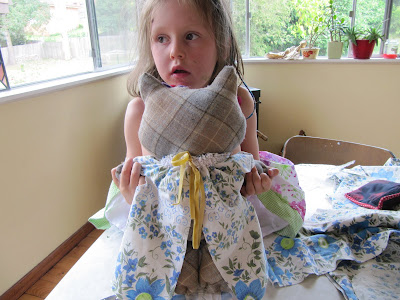
When I was cutting it out, Olive asked if she could help. Of course! I love having her hanging around helping when I'm sewing - it inevitably leads to her making up some elaborate, gorgeous costume/landscape/scenario involving the offcuts. On this occasion she decided she wanted to make a dress for her toys, so I grabbed the opportunity to show her how to make what I think is the cutest, simplest dress/top ever, which can be adapted for toys, babies, kids and adults alike.
It's based on a little top I had when I was a baby, which my mum made. I made a bunch for Olive when she was little, and a few for other cute babies I know as well. It's a really great, basic design, good for beginners, and it's easy to adapt and fancy-up, if you're that way inclined. Here's how it goes:
Firstly, measure the length you want the top to be. For Olive's Niki-cat, this meant floor length. Note that the edge on the left is a folded edge, so the rectangle Niki-cat is lying on is actually doubled over.
Now, make a long rectangle that is the length of the dress on one side, and 2x the total width of the bottom hem of the dress on the other.
Now, fold your long rectangle into quarters. Measure the length from Niki-cat's neck to her shoulder, and mark this same length from the top of the folded rectangles. Cut a little scallop shape half moon thing. This makes the sleeve (if you're making this top for anyone other than a toy, you'll probably want to encase the scallop-cuts in bias binding so they don't fray when you wash it).
Now, you need to make something to thread your drawstring through. We used some braid that I found on a council clean up, but if you don't have anything like that, just fold the top over twice and sew along to make a tube, kind of like if you were hemming it.
Now, thread your drawstring and pull it around the neck, then tie at the back. Cute stuff!
Depending on who you're making it for, and how often it's going to be washed etc, you'll want to finish off the hems and edges properly, either with bias or just by turning them under. Give it a go!
When I was finished making Niki-cat's frock, I got started on Megan's skirt, which was to be made using a phenomenal 'Australian Wattle' teatowel, which she and Ben hand-delivered to my workplace in Bega as they kayaked and camped their way up the coast from Melbourne to Sydney.
I LOVE the teatowel a) because of its unashamed intermingling of the common names and latin names of the wattles it features, b) because it's wattles, and wattles are cool and c) because it's from the wool capital of the world!
The skirt is pretty much exactly the same as the classic P&E A-line, but with no zip, a slightly gathered-above-the-rump thing, and a big wide stretchy band on the top to accommodate pregnant expansion.
THE COMFIEST SKIRT EVER. I wore mine looong after Olive was born, especially in the winter, when the stretchy band keeps all lower-abdominal areas extra-toasty.
I'd always been quite partial to a bit of wattle action, having been in the yellow wattle 'house' in primary school (you know the groups you're in for athletic carnivals and such??). When the local Landcare co-ordinator (also, handily, our neighbour) came to check out our land to see what was happening, we traipsed all over the place, oohing and ahhing over the many varieties of little baby seedlings coming up everywhere on account of the cessation of decades-long grazing. I felt so thrilled to see the diversity of native flora that was hanging out, just waiting for a chance to rise above the dairy-cow fodder. Amongst these many little seedlings and native grasses were several tiny Acacia mearnsii - Black Wattle.
Some people consider these to be weeds, but we choose to see them as an asset. Firstly, they are short-lived, meaning that you can use them as 'nursery' plants to shelter your precious fruit trees and delicate natives like Indigofera australis - Native Indigo - while they get established. While they're growing, supporting and sheltering your orchard, they're also fixing nitrogen in the soil, because they're leguminous. When they're growing, you can prune them and use them as mulch, and then when they die - more mulch! I don't know about you, but this all seems very exciting to me. And having nursery trees on a baby-growing skirt is pretty ace.

Saturday, November 5, 2011

We have a bit of a plan... by Pearl

You may recall our recent discussion around what we are actually going to do with our 7 acres. So this morn we 4 rolled out of our beds, a little bit excited, and breakfasted on pikelets and buttery pears sitting in the grass on our land in the sun while awaiting our site analysis and mini-consult with local permaculture trainer John Champagne.


We know that we want to grow enough food for ourselves and our visiting friends and family and that maybe we want to extend into some kind of semi-commercial venture in the future - olives? pomegranates? goats cheese? heirloom pumpkins? But right now we have a slopey block with no water and a bit of a weed problem. We also have two young children and not much money. Our experience of gardening to date has involved urban and suburban food growing and while we know you can do some truly amazing things with a suburban block, 7 acres provides a whole new array of possibilities.


Some books that have influenced our thinking and opened our minds to what's possible are The Earth User's Guide to Permaculture by Rosemary Morrow and Smart Permaculture Design by Jenny Allen. While an array of possibilities should equate to pure excitement I'd be lying if I didn't admit to some anxiety. It's odd how anxiety-inducing an array of possibilities can be (especially in a world that tells us that Choice is King), but maybe it's just a sign of my privilege, given how truly horrible a lack of possibility really is.

We talked with John about our ideas and about what we want to achieve, we wandered around the block and mentioned what we had observed so far. And within 2 hours he had drawn up the beginnings of a plan. It's a broad plan but it's a plan and frankly, it feels good.


For now we will be focussing on excavation. Far out. Big machine cutting into the earth and moving it around in order that we can build a house and garden that allows us to live more gently on the earth. Not entirely sure what I think of this, but maybe it's one of those things that requires more pragmatism, less thinking especially given our ex-dairy farm is far from being an unadulterated landscape. John must have noticed our soft city sensibilities warning us that the excavation would be somewhat traumatic and that the earth would indeed shake. Goodness. So we'll be sketching a little plan of what we want - driveway, studio site, house site, pond and a bit of extra flat-ness to aid in our Zone 1 veg patch and orchard and hoping against hope that the excavators can do it within our meagre budget. There'll be quite a bit of bush regeneration occurring, in part, to aid as a windbreak against hot westerly and northerly winds and to work as a shelter belt against bushfire but also to provide balance to the overall landscape. We'll be planting a woodlot in order that we can harvest our own wood to burn in winter. We'll be fencing an area for our immediate food production - fruit trees, nuts, berries, veg, herbs, chickens and ducks for eggs and meat with an eye and an ear to what else we may want to grow in the future.

Oh but we can't excavate until our D.A is approved. It's been lodged and the hefty fee has been paid. We're still reeling from the crazily mammoth heft of the fee. In the meantime we continue to research off grid solar systems, follow every lead towards free recycled hardwoods, search for cheap, local native plant tube stock, work out what where we can get a large number of excellent fruit and nut trees for the littlest amount of money and pontificate on exactly what the kids' cubby should be made of.