Showing posts with label poultry. Show all posts

Saturday, October 25, 2014

So we barter

When I was young and idealistic I entertained various fantasies of being self-sufficient: Building my own house, growing my own food, and basically being a hermit. No environmental footprint for me.
Now that I'm older (though still idealistic) my feelings about self-sufficiency have changed. For starters, I now have a family who don't necessarily share my hermit plans. But more significantly, now that we've really and whole-heartedly embarked upon a life where we are attempting to provide for ourselves in as many ways as we possibly can, we've realised how bloody hard it would be to actually produce everything you need by your own hands. Not to say that kind of life wouldn't be rewarding - I'm sure it would - but my feelings about 'how to save the world' have ripened a bit now, and my ideology has ultimately found a home in community-building.

What do I mean by that? Well, I mean talking to people. I mean valuing the work people do. I mean supporting people who are creating and growing things in our local area. I mean sharing and providing food for people. I mean sharing knowledge and information and encouraging people. And maybe more than anything else, I mean swapping and bartering as much as possible. 

One thing that hasn't changed for me since those heady early days of ideological veganism and Grass Roots idolatry, is my belief that money is pretty much the root of all evil. Unfortunately for us, (and even more unfortunately for the billions of impoverished and enslaved peoples around the world) we live under capitalism, which means that, short of the aforementioned hermit lifestyle, you kinda need to participate, at least a little bit, in the money economy. So what can you do about it? Well, you can be super-hyper vigilant about who you give your money to. Yes folks, it's true that under capitalism, one of your most powerful weapons is what you do and do not choose to spend your money on. Ask yourself: What kinds of things is this purchase supporting? Child labour? Slave labour? Crapy living conditions for factory workers? Environmental destruction? Cultural destruction? If you're answering yes to any of these questions, find an alternative, or go without.
Springvale community food swap at Linda and Paul's, down the road. What the heck kind of  shop comes with these views, cups of tea, cake and friendly advice about gardening and craft???
While that may seem like a kind of crazily austere or strict regime to adhere to, let me tell you that it's actually a ton of fun, because in the process of seeking alternatives, you'll probably meet people and make connections you wouldn't otherwise make, and you will strengthen your sense of community. By supporting local people you will build resilience in your community, and you will help people find alternatives to the confines of capitalism, even if just for a little bit. Liiiiike.... you might start or participate in your local food swap, or you might think of some other way you can barter for the things you need. 

And more food swap action at Autumn Farm

You might get involved with a local food co-op, or you might start buying your produce (and I mean all of your produce) direct from the person who grew it. You might start growing more of your own, and sharing it with a neighbour!

We are pretty much massive bartering devotees these days, bartering our chickens and craft for as much as we possibly can including acupuncture, veggies, fermented foods, art therapy,  spoon carving lessons, pork, art classes, lamb, hand-knitted gloves and bread. Yes, many of these things we could produce ourselves, it's true. But you know what? Our friends Thea and Tim have the most amazing market garden. But they don't have the time and inclination to also grow chickens, just like we don't have the time or inclination (or watering prowess) to grow massive beautiful bunches of coriander and celery. So we barter.
Bartered veggie box from Thea and Tim's Fish Bone Farm
 Similarly, our friend Emily makes incredible sauerkraut,  kefir and kimchi. Yes of course we could make these for ourselves, but that's her thing, so she's really good at it, just like we're really good at growing delicious chickens. So we barter.
Bartered fermented awesomeness courtesy of Emily
I can't knit, but I really wanted a pair of rainbow-hand-dyed fingerless gloves for riding my bike in the early morning chill, and Vee really wanted one of my skirts. Her handy man Grimm knits beautiful fingerless gloves. So we barter.
Awesomely awesome riding gloves knitted by Grimm, bartered for a skirt
You see what I'm getting at? By valuing other people's skills and interests, you don't have to be super-skilled at everything yourself. And besides which, sharing the love just feels plain old awesome.

Fish Bone Farm abundance gracing the Autumn Farm kitchen. Happy days..

Saturday, April 12, 2014

Fat Hens

As many of you will know, we have a little 'commercial' pastured poultry enterprise going on here on our little farm. I say 'commercial', rather than commercial, because any kind of economics-minded person would look at our set up and say it's not 'worth' it, 'commercially'. Perhaps true, if you're of that ilk, but for us, there's a lot more going on here than making a profit. Just as well, probably, cuz the profits just ain't that big... 

Luckily for us our chicken enterprise is rewarding and valuable for other reasons.
1. We're doing something we believe in, ethically, socially and economically: We treat our chickens and our land with respect, we feed our community good quality food at an affordable price, and we run our business in a way that is sustainable for us, for our community and the Earth.
2. We're contributing to the development of a local food system that is resilient.
3. We're doing something that allows us to spend time on our land, with each other, outside, which is (most of the time) really enjoyable. This one's kind of priceless as far as I'm concerned...
4. We're involving our kids in a business that is ethical and sustainable, teaching them that it's good to work (hard) for what you believe in, and that earning heaps of money isn't everything.
5. Our chickens are delicious!
These chickens are about to tuck into some fresh-cut fat hen
With all that said, though, it's not like we don't care about making a profit. Doing all the hard work (sometimes it's really really hard!!!) of pasture raising chickens and then selling them for no profit is just beyond our altruism levels. For this reason, we're working on ways to cut down on our input costs, by trying to grow as much food as we can for our chickens on farm. This, happily, also has positive environmental impacts for our business: the more food we grow, the less transportation (read: fossil fuels) is required to get the chookie's food into their beaks.
This chicken is eating some rocket
Obviously the biggest factor here is that we pasture raise our chickens, so they eat a crap-load of grass, seeds, bugs and snails that are just right there for the taking, meaning that unlike shed chickens, we don't import 100% of their food from someone else's farm. We don't do anything to cultivate our pasture, other than the odd slashing. It's naturally really diverse, with a mixture of annuals and perennials, summer and winter dominant crops, so there's not really a down-time. But the chickens do still need grain.
This chicken is eating a snail
Our grand plan was to pasture crop an acre of triticale this Autumn, but ye olde cancer diagnosis and recent mastectomy threw a spanner in those works, and we're going to have to wait til next year. Call us piss-weak, but experimental grain growing was just a little beyond our capacity at this time.
These chickens are eating microlaena seeds, and are about to stumble upon some sunflower seeds.
Chickens, in the mean time, are being satisfied with other grown-on-farm delicacies like gone-to-seed rocket, lettuce, spinach et al, and some sunflowers we kind of accidentally grew over the summer by way of spilt seeds that were left all over the paddocks by the chickens. Bonus! Next summer we might actually do it on purpose!
These chickens are enjoying some really big sunflower heads
The other big on-farm chook-feeder has been our extensive crop of fat hen, which we also pretty much grew accidentally. We've written about fat hen before, because we love it, but here's a super-cool little blurb from survival.org that really sums things up:

"Chenopodium album, Fat Hen, is probably named because chickens get fat from eating it. It has been used as a vegetable in Europe since prehistoric times. It grows faster and absorbs nutrients more efficiently than any crop, and can grow in almost anything. That plus the fact that it is also a rich source of nutrients makes it one of the most useful plants that there is."

OK!

It's proved to be an absolute boon for our chickens. They love it, and we take them bunches and bunches of it every day all through the growing season. 
This is a close-up photo of fat hen flower heads. The seeds are the little black dots
Now that it's going to seed, we're harvesting the seeds and adding them to the chickens' daily health porridge, which consists of wheat bran, ground sunflower and linseeds, apple cider vinegar, and kelp meal, and now, fat hen seeds. 
This lady-farmer has just mixed up a batch of super-health-chicken porridge, which she is about to deliver to her chickens.
They are digging it!

Monday, January 20, 2014

Autumn Farm in 2014

In my last post I mentioned that we had been working on a new rawbale chicken brooder house. The reason for this is that this year at Autumn Farm we're hoping to slowly increase the number of chickens we're growing for our community. 

Last year's chicken farming was a bit of an experiment, to see how we liked it, and how well it fit into the community's food needs/desires. Turns out it was a perfect fit on all fronts: We're sold on the farming thing, we're sold on being part of a local, co-operatively-run abattoir (I'm the new chairwoman!), we're sold on feeding our community locally and ethically produced whole food, and local peeps seem happy with Autumn Farm chicken being a regular part of their diet. Pearl was even interviewed as one of the 'Heroes of 2013' by the local ABC radio! Seriously, we were so proud of this, not least of all because of the other awesome people they picked out.

So yeah, we're going to grow a little. Not heaps - we don't want to overwhelm ourselves, and we don't want to over-burden our land: the aim of the game's regeneration, not overgrazing yo! We're just going to cautiously and slowly seek the balance between demand and what we can happily achieve. 

Step one in this journey was constructing a new brooder house. The old brooder house looked alright, but it was way too small and not that easy to work with. It had no insulation, and we found that the chicks had grown out of it by about 2 weeks. As we head into winter, they're going to need to be in the brooder for around 3 weeks, so we knew we had to make something bigger and better to keep those chickies safe and warm.
Day 1 inside the brooder house - it was HOT! So I added a paella-pan chick wading pool for them to drink out of while also cooling their tootsies. Newspaper is laid on the ground for the first couple of days so they can easily find their food and grit, which we scatter on the paper. Though as you can see, there are quite a few chicks already in the feeder, where they will probably stay for the rest of their days. Those little guys sure like to eat...

Being as we are super-keen on the strawbale, we decided to have a go at a rawbale (as in, unrendered) brooder house. The top of the bales are protected from rain by the roof, and the sides perform a bit like thatch, shedding any rain that hits the sides without allowing it to penetrate the bale. We're anticipating the house will last us a couple of years. When it starts to deteriorate, we'll dismantle it and use it as garden mulch. It's 2 courses of bales high (laid on edge), with a panelled recycled tin and laserlite roof, which we can take apart and tilt up as needed for ventilation and temperature control. There's a gas-powered brooder lamp inside to keep the chickies warm. The bales are pinned at the corners with star pickets hammered through the bales and into the ground, and the whole thing is wrapped in chicken wire. So far, it's been great!
A typical morning inside the brooder house. Yep. They're cute.

The chicks seem very happy in their new, spacious home, though they're still happy for some outside adventuring, which is a relief. It's important that they get a taste for grass/weeds/bugs/dirt as soon as possible, so they don't baulk at the prospect of eating heaps of greenery when they're moved out to pasture full time.
Autumn Farm chicks, 4 days old, venturing from their rawbale brooder house for the first time
In another week, they'll be moving into their new and improved moveable pasture house, which is moved every day to make sure they have fresh bedding. These houses are enclosed in electric mesh (the total run is 100 square metres for 130 chooks - a tad better than their 'free range' counterparts, who are currently enjoying about an A4 page per chook of dirt/poo inside a shed), which is moved every 3 days, so they have fresh green pick, and to make sure they don't over-excavate our land in their quest for fresh dust-baths.

It's a labour-intensive way to farm chickens, there's no doubt about it. And there were times (like after spending an hour and a half carrying the chickens to bed one night when they couldn't find the door to their newly-moved house) when I could definitely see the benefits to raising chickens conventional-style, in a shed. But the rest of the time, as we watched them on the grass, hanging out, doing chicken stuff, foraging, flapping etc, and then when we tasted them, we knew that labour-intensive pasture-raising is THE ONLY WAY TO GO.

Which is why we're doing it some more.

Wednesday, January 15, 2014

A bit of what we've been up to...

We had a little lapse from blogging over the Christmas/holiday/visitor season, so this is a bit of a catch up on what we've been working on/eating/enjoying.

We've been experimenting with new ways to eat eggs for breakfast (or lunch, or dinner...), like in the recipe at the end of this post.


We've been enjoying the very first blackberries, making plum jam, and drying chillies.

We've been eating Autumn Farm chickens for Christmas lunch, making pulled pork in the pizza oven (8 hour slow roast - yeeeeaaaaahhhhh....) and eating it on rolls with home-grown coleslaw. 

We've been building a new rawbale brooder house for our Autumn Farm chickies, and falling in love with our 13 new baby ducklings.
We've been pickling eggs (!) and eagerly awaiting the opportunity to taste them.
We've been feeling inspired by new books like Food DIY, and Practical Self Sufficiency, and trying out new recipes (like pulled pork, coleslaw and pickled eggs).
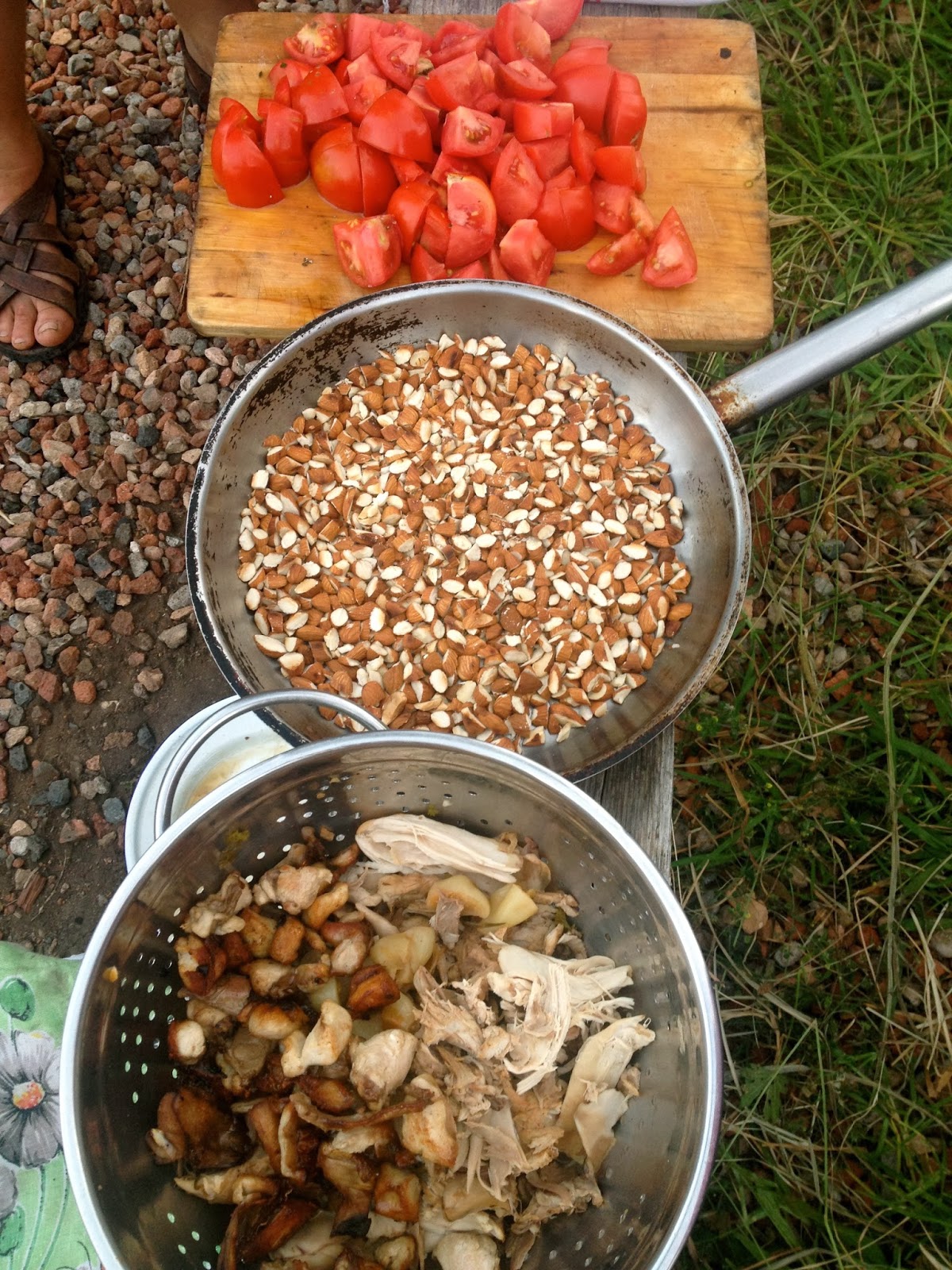
We've been celebrating old and new years with friends by cooking an enormous wild rabbit, rosemary and almond paella over the fire - YUM! - and drinking copious amounts of home brewed beer and rhubarb champagne.
We've been swimming at the beach and in our dam, fishing, kite-flying, and watching in awe as a pod of dolphins passed us by on their own (far more successful) fishing expedition at Bithry Inlet.
We've been welcoming new babies by sewing onesies and baby quilts.

We've been feeling super lucky to be enjoying visits with friends and family, showing them the wonders of our neighbourhood.

We've been harvesting garlic, zucchinis, tomatoes, beans and zucchinis, and wishing we'd planted more parsley.

And we've been feeling super super grateful for all of these things - and more! - and wondering what the year ahead has in store for us...

And now for a little recipe-sharing, in the form of our new favourite way to eat eggs, inspired by our friend Yotam Ottolenghi and his friend Sami Tamimi and their book Jerusalem.
First up, I fried a chopped onion in some olive oil with a whole bunch of garlic.

Then I added a teaspoon of ground cumin and 2 teaspoons of sumac, a couple of bits of preserved lemon, some finely chopped chard leaves and some chopped tomatoes, and cooked it all up til it was kind of saucy.

Then I cracked in some eggs and put the lid on to let them poach in the sauce.

When the whites were set (yolks still runny!!) I served it up with some of Pearl's flatbreads, some more sumac, and a yoghurt, tahini and lime juice dressing.

It was crazy good, and we highly recommend you give it a go.

Friday, January 10, 2014

Ah pâté... Ain't nobody don't like pâté...

I'm not sure when I first ate pâté, but I must have been young. I seem to have many childhood memories of devouring a lot of pâté. I don't know if they're real imaginings or as frequent as I recall, but I can still taste that deliciously unique creamy richness. As a child I piled the crackers high with big chunks of the stuff and this is the way I eat it now. Nothing delicate here. 

Truth be told, I didn't eat pâté for years and years. That stuff with jellied peppercorns atop it in plastic packaging has never really appealed and eating liver from an animal of dubious sources freaks me out. It feels like pâté is pretty much bad fashion on a plate these days, which means we are either very much behind the times or very much cutting edge here because we have been eating A LOT of pâté here at Autumn Farm. And why not? We have access to some pretty delectable pasture raised chicken's livers these days. And to make this story even more feel good, it is said that liver is the most nutritionally dense food you can eat. A-mazing. 

When people buy our whole chickens they can also get hearts, livers, feet, gizzards, necks by the kilo. While lots of the bits end up as pet food, the orders started coming in for the livers with people telling me, 'I'm going to have a go at making some pâté..." Pâté?! Oh wow, that taste of my childhood returned to me and I got a little bit pâté curious. Then I read this lovely post and my return to pâté was confirmed. My childhood pâté memories centre around my parent's dinner parties and family lunches, and then there was that brioche and pâté extravaganza at my mum's 40th birthday party... Annie's childhood pâté memories are of a more Germanic variety. At her Oma and Opa's she ate a lot of liverwurst on black rye with radish or mustard. At home, she ate it on white with pickles. How we both eat it now is entirely influenced by those formative experiences.  

My preferred mode - on toasty sourdough with leaves and tomatoes from the garden

Annie's preference is with homemade pickles
I'm still amazed that something so luxuriously delicious could be so cheap and easy to make. Sadly I think my amazement just reveals how out of touch with eating simply and well we have become in the west. We are supremely lucky in that we have a ready supply of chicken livers we feel very comfortable consuming. Annie's work at the abattoir has confirmed for us just how good our livers are. Our chickens have livers of deep deep red and they smell sweet. Some other chickens that have consumed a different diet and lived a different life have livers that appear, well, sick and pale browny coloured, and they smell yuck. I know I know, some of you may be wondering where you can get these sweet smelling livers from? If you don't live in the Bega valley then I cannot really say. You need to find yourselves a butcher who can guarantee the provenance of the meat they're selling you. If you're in Sydney, you would want to try these fine fellas

The pâté recipe I have been using is a little fusion of what we have at home + Emily's + Matthew Evans + a little bit of internet searching... and it goes a little something like this - 
250g butter (Bega butter of course!)
2-3 brown onions, finely chopped
3-4 garlic cloves, crushed
5 sprigs of thyme
2 sprigs rosemary
a small sprig of sage
500g chicken livers
a splash of red or white wine or port

Slowly cook onions in the butter until onion is soft but not brown. Add the herbs and garlic and cook a little longer. Add the livers and cook for 15 minutes until livers are cooked through. Add a splash of wine or port and cook for a few minutes more. Add a little salt and pepper to taste. Then blend in a food processor until smooth. 

How easy is that?!
I read somewhere that it freezes and thaws really really well. I ask you, can this story get any better?

Basically we have had a continuous supply of pâté the past four months and we're so not sick of it yet. We've had many visitors from Sydney and I've fed them all pâté. I like to think of it as a little something special we can offer our friends from the big smoke. It's true, we don't have fine theatre or cinema or very much hustle bustle but we do have very fine pâté. And we also have very fine beaches and what could be finer beach food than pâté on sourdough, with a little home grown cherry tomato chaser? Seriously good stuff, the kind of stuff that makes my heart sing.   
Eating pate' while gazing upon this feels pretty good

Saturday, November 30, 2013

"Is this meat?"

We've been doing a bit of meat processing of late - pigs, lambs and, of course, chickens. The kids have been with us all the way, interested and enthralled by the process, and it's prompted them to become quite engaged with the question of what meat actually is. Oscar in particular went through a process of trying to discern what else in his life might be considered a meat possibility. Pointing at the dog: "Is this meat?" Pointing to his cheek: "Is this meat?" The answer to his question, of course, is that what can be considered 'meat' is completely subjective and socially determined.
Slow-cooked Spanish style wild rabbit stew, made using home-cured chilli pancetta, served with soft polenta. A 'normal' kind of 'meat', but why?

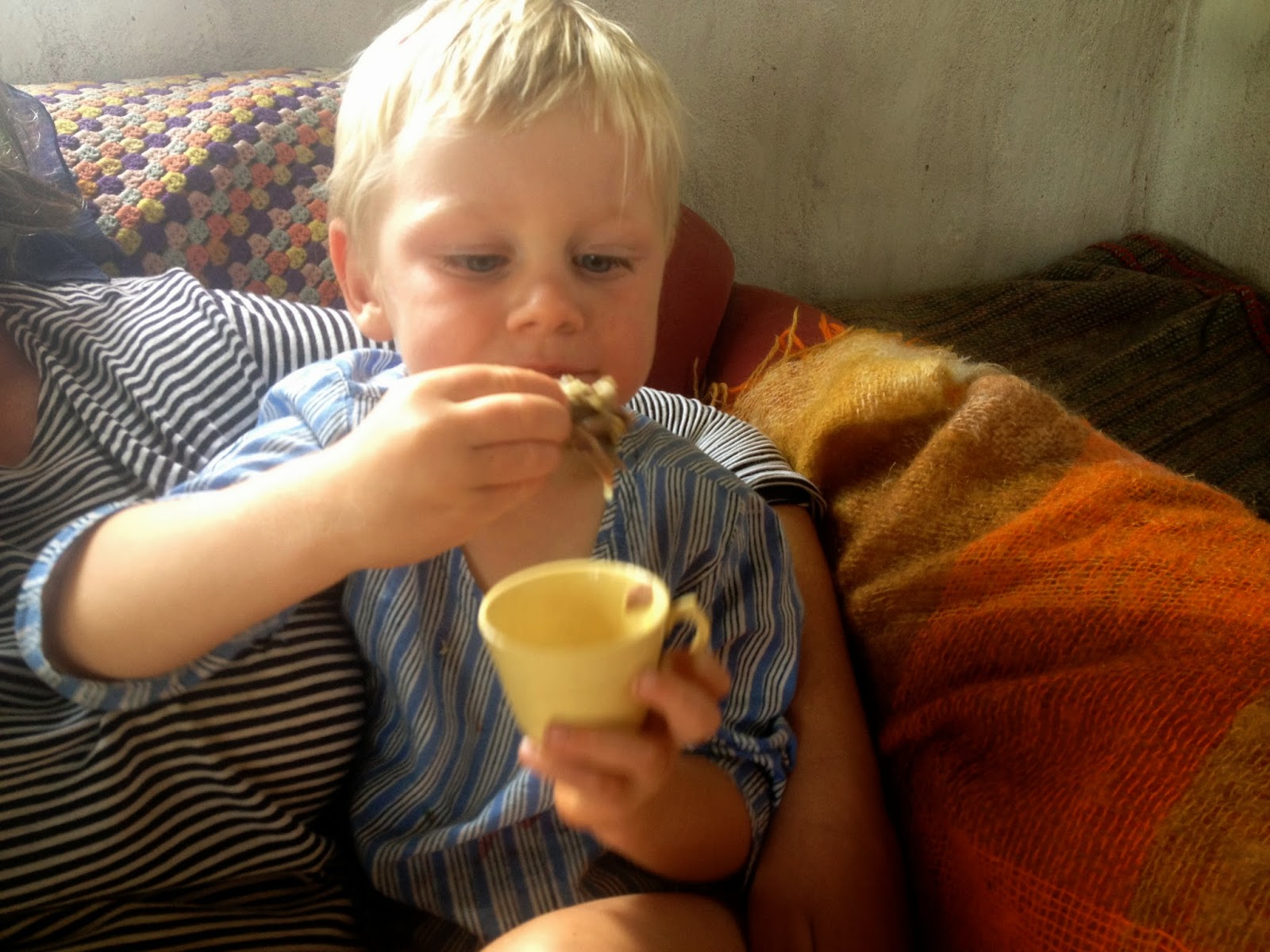
Oscar,  having not been at all socialised to reject certain kinds of meat potentials, is all for considering the possibilities. For this reason, he was the only person in our family to try the lamb's tongue. He loved it! Gulping it down from a little yellow tea cup while watching Gourmet Farmer on DVD.
Oscar enjoying his cup o' tongue
He was also the one who prompted me to consider the meat potential of chicken necks, which I regularly bring home from the abattoir for making stock, which we use in everything, but most deliciously, in congee
One day, after the stock was done and packaged and safely deposited into the freezer, Oscar came upon the colander of chicken necks, onions and celery tops. "What's this? A sausage?" he asked, holding up one of the necks. "Yeah, kind of." I replied, at which point he started chomping on it. The upside to his adventurousness is that he now has a super-nutritious snack of 'neck sausages' every time I make stock, and I discovered that necks actually have heaps of meat on them. So now, when I make the stock, I spend 10 minutes or so afterwards stripping the necks into a neat little parcel of beautiful, cooked chicken meat for sandwiches or soup or whatever. Yum!

When we recently processed our lamb, I was keen to make use of the lamb's head, which I knew would contain quite a bit  of meat - too much to discard, for sure.
The lamb's head. Most of the meat came from the cheek areas
The answer came in the form of a Iranian breakfast soup called Kaleh Pacheh, which is traditionally made with the head and the hoofs of the lamb. For some reason the hoofs were fed to the dogs, so I just used the head. I used the recipe in the link above, though I added some apple cider vinegar to help get the goodies out of the bones. We cooked it (overnight!) in our pizza oven, so it was a nice long, slow cook. Next day, I stripped the skull of all its meat and stirred it through the broth.
Kaleh Pacheh - served with a squeeze of lemon and a freshly-cooked home-made flatbread
The resulting soup was a gorgeous green colour, not too chunky, herby, and quite rich. It's got an interesting flavour, and though I don't mind having things like congee with poached eggs for breakfast, I don't know that I'll be rushing to have Kaleh Pacheh first thing in the morning, though it made a delicious light lunch.
Leftover congee with poached eggs - possibly my favourite breakfast
Despite my attempts to challenge my "is this meat?" socialisation, I didn't taste the tongue, and I didn't put the eyeballs in the soup. Which made me realise how strong and pervasive this socialisation is. Here I am, philosophically and ethically completely in favour of eating all bits, and I still had insurmountable "ew" about the eyeballs and tongue. Interesting.

Next stop on our "is this meat?" adventure is my Oma's braun, which we are making from the head of our pig, which is safely waiting in the freezer. I'm excited - I know it will be delicious - but also apprehensive about overcoming my 'ew' enough to use and eat the tongue, to get all the hair off the pig's head, clean out the ear wax etc... But I'm up for it. We have to be, because we all waste so much, and a socialised 'ew' to perfectly good, readily available, local food is something worth challenging.

Friday, November 29, 2013

How sweet!

Yesterday afternoon I went up to the orchard to toss some leftovers to the chickens, and started shrieking like a lunatic. Pearl and Olive rushed out to find out what was wrong, and I gleefully informed them that one of the baby chicks had hatched. And how sweet it is!
Even though we've had quite a lot of baby chick action in the last 3 months (like, 300 of the little fluffballs), this one seems (maybe) extra tiny and (definitely) extra cute. Or maybe it's just the way it interacts with its 2 mums, who are following it/guiding it around the place, finding food for it, showing it how to drink, and scaring off chickens/ducks/kids if they get too close. It's SO CUTE.

I'm not holding out much hope for the other eggs they'd been incubating, though. They seem completely wrapped up in caring for their little baby, and have abandoned the other eggs. So it looks like it'll just be the one little chickie then. What a chickie it is!!!

Wednesday, November 27, 2013

News from the orchard, part 3: Double mummas

You may (or may not) remember that last summer, we had a sitting duck and a sitting hen. We were very excited about the prospect of babies but, alas, the babies did not hatch, on account of the poor birds sitting through two 45+ degree days. Yep, it was frikkin' hot, and poultry embryos weren't up for it. We also lost a hen, but stories abound of people losing whole flocks of chickens, prime breeding rabbits, goats, sheep... It was a terrible couple of days. So we got off light.

Anyways, we're hoping the current lot of broodies have a better time of it, and hopefully hatch some babies!

The current broody season started off with one of our light sussex hens on a clutch of about 14 eggs. A week or so into her sit, a second light sussex also started to brood on her own clutch, but she was so aggressive I couldn't get anywhere near it to count the eggs. We got these hens from a neighbour down the road, and everyone we know who got hens from this neighbour all have broodies right now. Reliable, it seems. Anyways, a few days before the first clutch were due to hatch, that broody hen abandoned her nest to join forces with the second sitting hen. Seems they're picking up on the double mumma vibe that's going on around here...
Apparently it's not exactly unusual  for 2 hens to sit on the one nest and co-parent the hatched chicks. All the usual benefits apply: 2 hens mean that the eggs get kept warm while one hen goes off the nest for food or water. 2 hens also mean that once the eggs hatch, the chicks have double the protection, as both hens work together to look after the chicks. And of course everyone knows that children from same-sex parents have statistically better academic and social outcomes.

Hilariously, the hens aren't the only ones joining in with the double mumma thing: we also have a pair of ducks sitting together. I know!! What is going on around here??!! I have no idea how many eggs those girls are on, but we're all really hoping the ducklings hatch on account of the fact that baby ducks are outrageously cute!!
We do also have another duck sitting (alone) on a very serious-looking nest in a patch of broadbeans behind the pizza oven. I have no idea how long she's been there (we only noticed her on the weekend, when we were cooking pizzas) or what she's sitting on - she is incredibly conscientious about thoroughly covering up her eggs when she leaves the nest for a forage in the grass. So if and when she hatches her eggs, it'll be a lovely surprise!

Wednesday, May 15, 2013

News from the orchard part 2: the quest for a fox-proof chook house

Olive tends her flock - Errol's in the foreground with the glorious orange neck feathers, new 'Fort Choox' chook house behind
Fox-proofing the poultry community on our little farm has proved to be more difficult than we anticipated. When we first got the ducks, I made a dome. It was dodgy as all shit on account of the fact that I used the wrong kind of pipe, but we didn't have any trouble with foxes, though in hindsight I think that had more to do with the fact that our neighbours were baiting because it was lambing season. Just before we got the chooks, we built a snazzy A-frame house, which was, I thought, fox proof. Not so much. We had a few break ins, lost a few chooks, and I even spent one night in the orchard on an inflatable mattress chasing the fox off before I decided that the A-frame had to go. I'd patched it and patched it, and the mongrel fox was still getting in. We needed a new plan, a new design. So I consulted with my ever-helpful and thoughtful friend David, who had become quite interested in our fox-proofing plight (he enjoys a challenge). After many sketches, home-brew sessions and whiteboard-planning meetings, we devised a fox-proof chook house that fulfilled the following criteria:
1. Zero cost 
2. accessible for kids to let out/put chooks away/collect eggs 
3. FOX PROOF 
4. includes a run so we can go away for a night or 2 without having to organise for someone to come and lock up/let out chooks 
5. comfy for chooks.
Chook house almost complete
The house we made was kind of inspired by Milkwood's rawbale chook house, though we obviously didn't use bales. We did borrow their idea of having a mesh floor for ventilation in summer, which is covered in thick straw in winter. And the house is (obviously) raised off the ground to thwart that fox digging his or her way in. Walls are corrugated iron (bastard fox ain't gonna chew through that in a hurry), held up with bush poles from David's place, floor mesh came from some supermarket shelving that was being chucked out, all timber was scrap from other projects/salvaged from the tip, and the pen is made from mattress springs that are dug into the ground down to 40cm. We'll be planting passionfruit vines on either side, to climb on the mattresses to provide shade in the pen during summer. It took about 10 hours to build (4 hours with David's help), not including the time it took to dig the trenches for the mattresses and holes for the bush poles.
At the moment, we have 8 chickens living in it (John Howard (our breeding rooster), a rooster we'll be eating as soon as he starts to crow, Errol, and 5 laying hens), and I reckon that's about the limit. When we expand our flock to include commercial meat birds, we'll be building more pens a-la Joel Salatin. But for the purposes of the orchard, 8 chooks (and 11 ducks) is just fine.
The back door - for chook ingress/egress, egg collection and house-cleaning
All in all, the chooks seem to dig it, and we've had no evidence that the fox has been hanging around or trying anything out. It's easy for Olive to tend to her flock (especially Errol, who is currently preparing for the Far South Coast Annual Poultry Show), and, if I do say so myself, it's pretty good to look at. Though it seems to me you can't really go wrong with bush poles, old gal and beautifully rusted mattress springs...
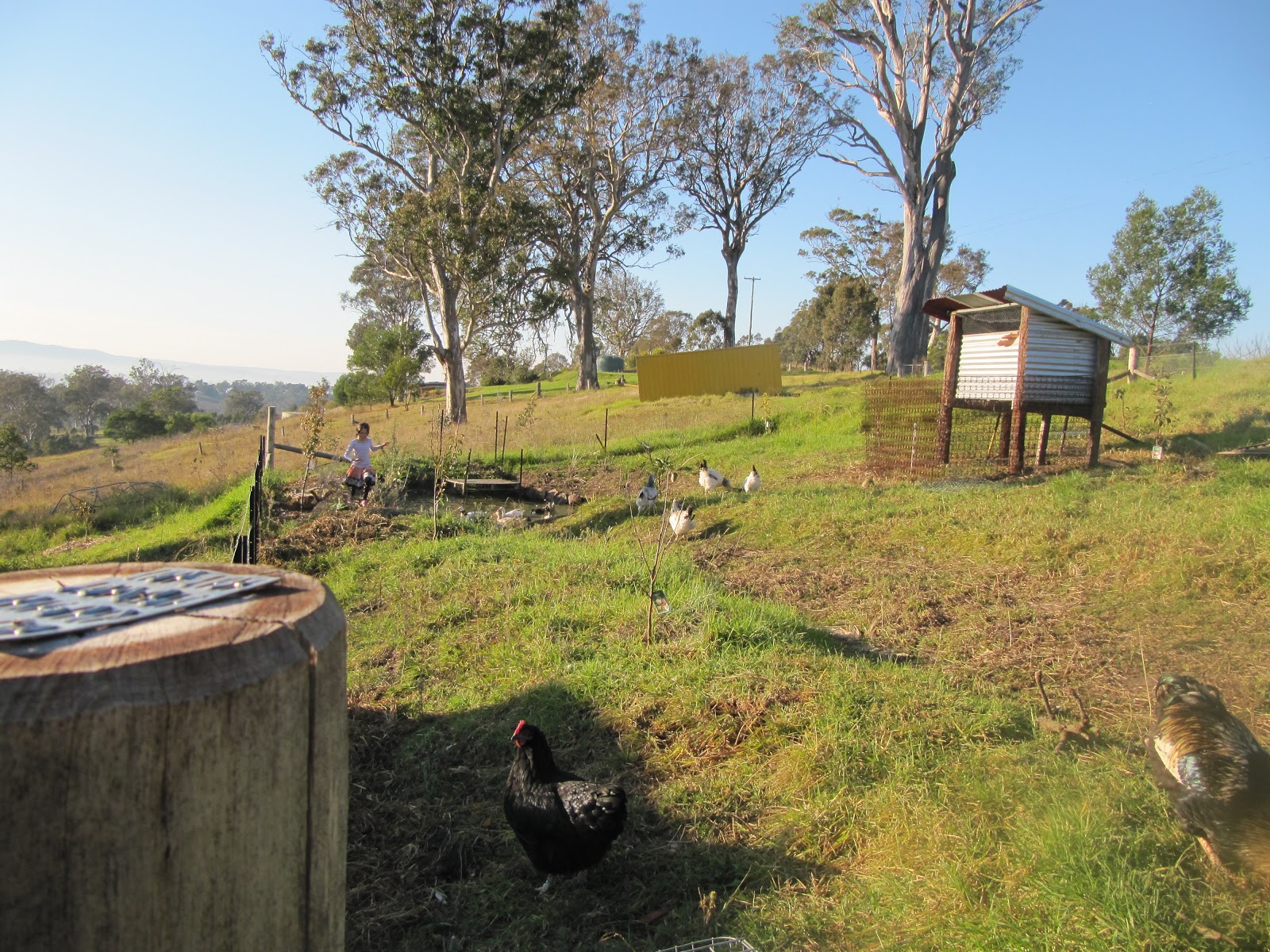
View down the orchard showing swale to duck pond, chooks and chook house