Showing posts with label strawbale building. Show all posts

Saturday, February 7, 2015

The next big adventure

Almost 3 years ago, we broke ground to make way for the tiny handmade strawbale house we currently call home. It was a momentous occasion for us, full of mixed feelings, and it was the beginning of a journey that basically consumed us for the following couple of years.

Building the tiny house was always a bit of a 'suck it and see' kind of exercise - to find out if we could really build our own house. Turns out we could! It was really hard at times, but it was always rewarding. And we so thoroughly enjoyed the experience of building, and have so thoroughly enjoyed living on our land, in our little handmade home, we're doing it again.
4 year old barefooted pirates are invaluable on the building site
In the last few months we've begun to slowly make moves towards building a second, slightly less tiny, slightly more luxuriously appointed (internal plumbing!!) handmade strawbale house. We don't have heaps of money, and we certainly don't want to go into debt, so things will be slow-going, as we plan to save a bit, build a bit, over the next few years.
Shadow of a shovelling lady
Building the tiny house has given us an excellent perspective on what we really want and need from a home, and what we can and can't manage to build by ourselves. We've discovered a few things we're going to do differently second time around (45 degree pitch roof? No thank you!), and a few things we're definitely going to do the same (strawbale? Most certainly!). If you're thinking of building your own home, it's something to seriously consider: I believe that building this place was the single best thing we've done in the last 5 years. The knowledge, skills and perspective it's given us - not to mention the savings in rent and bills! - have been absolutely invaluable, and we're very grateful to have had the opportunity.

So what are we planning to build next?
It's pretty basic: a strawbale rectangle with a skillion roof, containing 3 very small bedrooms, a fully strawbale-enclosed cool pantry (bigger than the bedrooms - food storage takes priority over sleeping space in this family!), a nice, open, functional kitchen, a beautiful warm eating area, and a lounge space with a wood fire that doubles as an oven and stove. 
Oscar and my dad laying the pipe that will carry our greywater directly to an absorption trench in our zone 1 garden
External walls will be rendered strawbale, internal walls will be framed using recycled wood pallets, clad with reclaimed corrugated iron and fence palings. Our experiences over the last few years of bathing outside have prompted us to forego an internal bathroom in preference of more kitchen space, with a primitive, outside greenhouse/shower-room combo to complement our existing firebath, which we love so much! We're also going to have another outside, composting toilet.
Footings full of water, which our dogs think of as purpose-built doggy-lap-pools, much to the detriment of the footings themselves
But for now, all we have is a kind of muddy area with some footings full of water, and pier-holes full of frogs, and occasionally children. 
Oh and a 110 000L tank that is collecting water off its own roof until we get it hooked up to the house. Not terribly appealing or inspiring, but it's a start, and our minds and hearts are busy and full, as we dream of this next big building adventure.

Saturday, February 1, 2014

Life and Death

Born again farm cat, watching over her veggies
A few months back, my fellow chicken grower/abattoir worker and general farming mentor Mandy said to me "Farming's really all about loss". This seemed like a dire assessment at the time, but I figured she'd know - she and her lovely family run Symphony Farm, which is an amazing, integrated, certified organic property in Tilba. She's been farming her whole life, as has her husband and all their (now grown up) kids.

The last week, we've learned first hand a little bit about what she meant. It's not so much that farming is all about loss - see our last blog post, for an example of the joys - more that your farming life is kind of defined and ruled by loss and the avoidance of it.

A week and a half ago, our then-week-old chicks started dying. They basically haven't stopped. After talking to experienced chicken farmers and hearing the findings of my mum's thorough research, we thought we'd narrowed down the cause of the fatalities to the new rawbale brooder house. Turns out there is a condition affecting young chicks that can be caused by spores that grow in strawbales. We decided this was our problem, so dismantled the brooder house (a humbling experience) and hurriedly built a new brooder out of corrugated iron. The deaths slowed, but still haven't stopped, despite the 2-6 day incubation period having passed.

We've also had days and days of hot weather, which gives us the challenge of keeping the chicks within a safe temperature range - lots of wet towels and water dishes around the place is pretty much the best we can do.

We know some other people who got chicks from the same batch from the hatchery, and they are also having problems. It's not so much that there is a single lot of symptoms affecting all the sick chicks, more just that the chicks seem to be very weak, not resilient, and lacking an appetite. It's upsetting, to be sure, and frustrating because we have no idea how to help the situation and make it stop. All we can do is take extra care (we've set up a little hospital inside our house for the ailing chicks, and have had some success with recoveries) and make sure the chicks are comfortable and eating well - kale, kelp meal, brewers yeast, and apple cider vinegar are all on the menu in addition to their normal rations.

In this midst of all this, we had another, more devastating decline in one of our animals. My beloved cat, Bunn, who has been my cat companion for my whole adult life, went from sleeping a lot (kind of OK given she's an old lady), to not being able to walk, to barely breathing in the space of about 24 hours. After sitting up with her all night, patting her and crying, I made the agonising decision to have her euthanased. We are all very sad. She's been such a constant in our lives, from inner-city alley cat, moving through all my many and varied share houses in the Inner West of Sydney, to born-again farm cat traipsing through the paddocks and enjoying the strawbale windowsills at Autumn Farm. I'm glad that this is her final resting place. She will be missed.
Bunn's last photo - helping the kids with their camp fire, where they were busy cooking a "buffalo leg"
Red oak lettuces were a particular favourite resting spot
And cookbooks in the sun
The night we buried Bunn, our dog Sock - Mr A1 Fox Chaser here at Autumn Farm - was helping me with the chicken rounds when he ran out onto the road and was hit by a car. He broke his tail, and also his pelvis in 3 places. Euthanasia was also on the cards for him, until the vet reconsidered his age. She said she's seen good recoveries from breaks much worse than his, given 12 weeks of cage rest. So more nursing our very sore and sorry pup, who is to be confined in his cage for the next few months dining on vegetable and chicken broth, and chicken hearts and livers.
Sad Mr Sock in his convalescent cage
It's been a sobering, humbling experience for us. We are still so grateful for everything we have, and we know how minor our losses are in the scheme of what some people experience in their lives and on their farms. 

And we do have some beautiful things to be grateful for in spite of the sadness. 8 baby ducklings, abandoned by their mother the day they hatched are now living with us (in our tiny house during the night, and in our veggie garden during the day) after being brought back from near-death with the help of a hot water bottle. 
The ducklings by day - today they've been feasting on lettuce and basil
The ducklings by night, with their cozy hot water bottle 'mummy'
They're cute little things, and a timely reminder that the vagaries of life on a farm aren't all bad, and that life and death are just all part of the grand scheme.

Monday, January 20, 2014

Autumn Farm in 2014

In my last post I mentioned that we had been working on a new rawbale chicken brooder house. The reason for this is that this year at Autumn Farm we're hoping to slowly increase the number of chickens we're growing for our community. 

Last year's chicken farming was a bit of an experiment, to see how we liked it, and how well it fit into the community's food needs/desires. Turns out it was a perfect fit on all fronts: We're sold on the farming thing, we're sold on being part of a local, co-operatively-run abattoir (I'm the new chairwoman!), we're sold on feeding our community locally and ethically produced whole food, and local peeps seem happy with Autumn Farm chicken being a regular part of their diet. Pearl was even interviewed as one of the 'Heroes of 2013' by the local ABC radio! Seriously, we were so proud of this, not least of all because of the other awesome people they picked out.

So yeah, we're going to grow a little. Not heaps - we don't want to overwhelm ourselves, and we don't want to over-burden our land: the aim of the game's regeneration, not overgrazing yo! We're just going to cautiously and slowly seek the balance between demand and what we can happily achieve. 

Step one in this journey was constructing a new brooder house. The old brooder house looked alright, but it was way too small and not that easy to work with. It had no insulation, and we found that the chicks had grown out of it by about 2 weeks. As we head into winter, they're going to need to be in the brooder for around 3 weeks, so we knew we had to make something bigger and better to keep those chickies safe and warm.
Day 1 inside the brooder house - it was HOT! So I added a paella-pan chick wading pool for them to drink out of while also cooling their tootsies. Newspaper is laid on the ground for the first couple of days so they can easily find their food and grit, which we scatter on the paper. Though as you can see, there are quite a few chicks already in the feeder, where they will probably stay for the rest of their days. Those little guys sure like to eat...

Being as we are super-keen on the strawbale, we decided to have a go at a rawbale (as in, unrendered) brooder house. The top of the bales are protected from rain by the roof, and the sides perform a bit like thatch, shedding any rain that hits the sides without allowing it to penetrate the bale. We're anticipating the house will last us a couple of years. When it starts to deteriorate, we'll dismantle it and use it as garden mulch. It's 2 courses of bales high (laid on edge), with a panelled recycled tin and laserlite roof, which we can take apart and tilt up as needed for ventilation and temperature control. There's a gas-powered brooder lamp inside to keep the chickies warm. The bales are pinned at the corners with star pickets hammered through the bales and into the ground, and the whole thing is wrapped in chicken wire. So far, it's been great!
A typical morning inside the brooder house. Yep. They're cute.

The chicks seem very happy in their new, spacious home, though they're still happy for some outside adventuring, which is a relief. It's important that they get a taste for grass/weeds/bugs/dirt as soon as possible, so they don't baulk at the prospect of eating heaps of greenery when they're moved out to pasture full time.
Autumn Farm chicks, 4 days old, venturing from their rawbale brooder house for the first time
In another week, they'll be moving into their new and improved moveable pasture house, which is moved every day to make sure they have fresh bedding. These houses are enclosed in electric mesh (the total run is 100 square metres for 130 chooks - a tad better than their 'free range' counterparts, who are currently enjoying about an A4 page per chook of dirt/poo inside a shed), which is moved every 3 days, so they have fresh green pick, and to make sure they don't over-excavate our land in their quest for fresh dust-baths.

It's a labour-intensive way to farm chickens, there's no doubt about it. And there were times (like after spending an hour and a half carrying the chickens to bed one night when they couldn't find the door to their newly-moved house) when I could definitely see the benefits to raising chickens conventional-style, in a shed. But the rest of the time, as we watched them on the grass, hanging out, doing chicken stuff, foraging, flapping etc, and then when we tasted them, we knew that labour-intensive pasture-raising is THE ONLY WAY TO GO.

Which is why we're doing it some more.

Wednesday, January 15, 2014

A bit of what we've been up to...

We had a little lapse from blogging over the Christmas/holiday/visitor season, so this is a bit of a catch up on what we've been working on/eating/enjoying.

We've been experimenting with new ways to eat eggs for breakfast (or lunch, or dinner...), like in the recipe at the end of this post.


We've been enjoying the very first blackberries, making plum jam, and drying chillies.

We've been eating Autumn Farm chickens for Christmas lunch, making pulled pork in the pizza oven (8 hour slow roast - yeeeeaaaaahhhhh....) and eating it on rolls with home-grown coleslaw. 

We've been building a new rawbale brooder house for our Autumn Farm chickies, and falling in love with our 13 new baby ducklings.
We've been pickling eggs (!) and eagerly awaiting the opportunity to taste them.
We've been feeling inspired by new books like Food DIY, and Practical Self Sufficiency, and trying out new recipes (like pulled pork, coleslaw and pickled eggs).
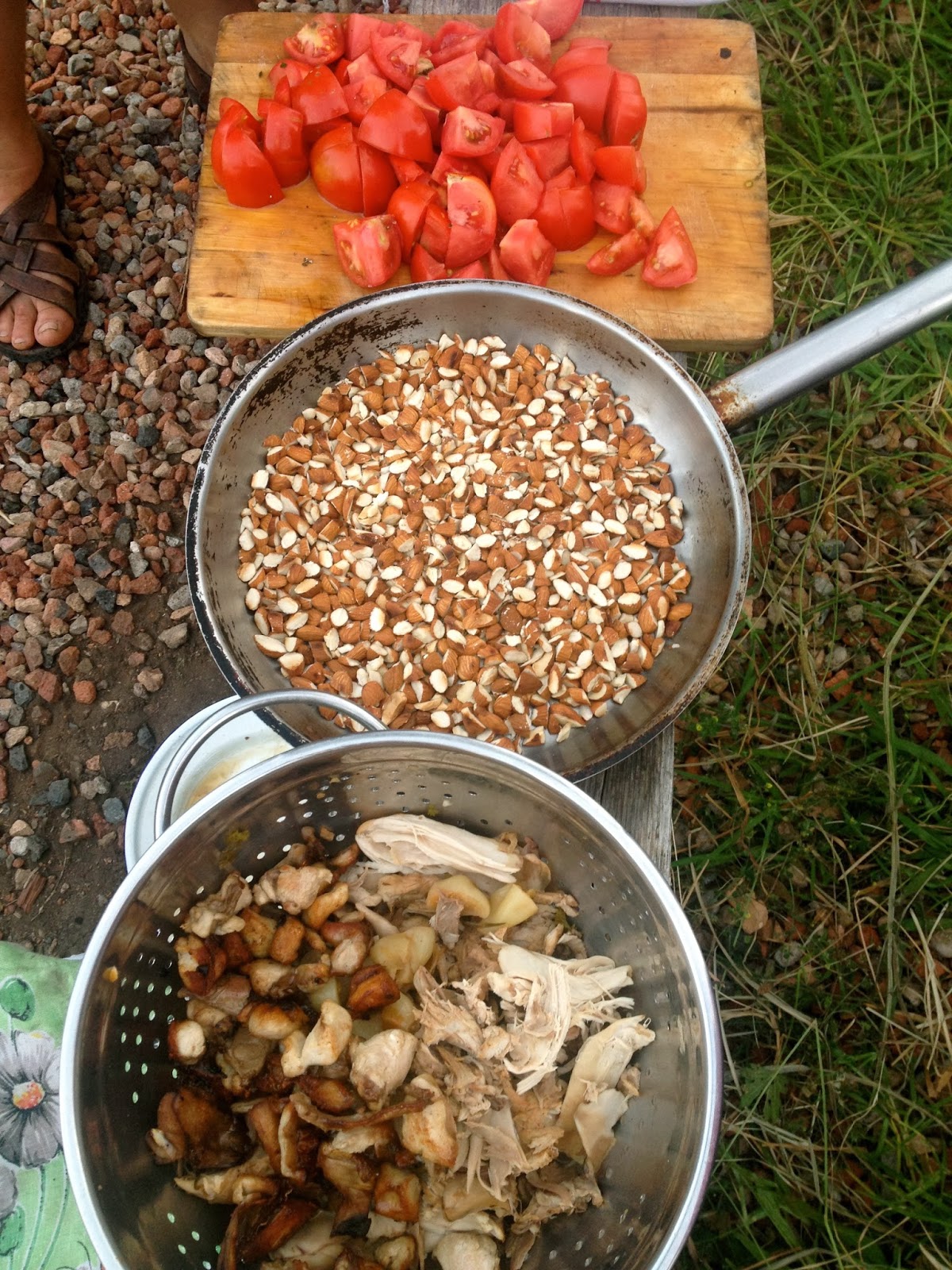
We've been celebrating old and new years with friends by cooking an enormous wild rabbit, rosemary and almond paella over the fire - YUM! - and drinking copious amounts of home brewed beer and rhubarb champagne.
We've been swimming at the beach and in our dam, fishing, kite-flying, and watching in awe as a pod of dolphins passed us by on their own (far more successful) fishing expedition at Bithry Inlet.
We've been welcoming new babies by sewing onesies and baby quilts.

We've been feeling super lucky to be enjoying visits with friends and family, showing them the wonders of our neighbourhood.

We've been harvesting garlic, zucchinis, tomatoes, beans and zucchinis, and wishing we'd planted more parsley.

And we've been feeling super super grateful for all of these things - and more! - and wondering what the year ahead has in store for us...

And now for a little recipe-sharing, in the form of our new favourite way to eat eggs, inspired by our friend Yotam Ottolenghi and his friend Sami Tamimi and their book Jerusalem.
First up, I fried a chopped onion in some olive oil with a whole bunch of garlic.

Then I added a teaspoon of ground cumin and 2 teaspoons of sumac, a couple of bits of preserved lemon, some finely chopped chard leaves and some chopped tomatoes, and cooked it all up til it was kind of saucy.

Then I cracked in some eggs and put the lid on to let them poach in the sauce.

When the whites were set (yolks still runny!!) I served it up with some of Pearl's flatbreads, some more sumac, and a yoghurt, tahini and lime juice dressing.

It was crazy good, and we highly recommend you give it a go.

Tuesday, August 27, 2013

Now that's my idea of a party!

The common wisdom about owner building is that you shouldn't move in until the house is finished. If you do, it's likely that you'll never finish. Being determined, like I am, I thought we'd be immune to this. A year and a bit in, though, we still have quite a bit to do until our little house is completely 'done'. One of those things is the external rendering. After the mad rush of late-night and all-weekend rendering we did to get the inside finished so we could move in, we were pretty keen to have a break from the old render activity. It is, after all, quite hard, and not that fun.

So our outside render remained at various stages of one third to two thirds done - exactly as it was the day we moved in. It's been there, looming on various to-do lists, but always manages to be shafted by something more fun, like planting 800 landcare trees. Now that's what I call a good time!

We knew that getting the render finished was going to call for some drastic measures, and that drastic measure came in the form of a render, pizza and beer party for my birthday, thus combining a few of my favourite things: beer, pizza, friends and productivity. Need I say it? Ace balls.
Luckily, people seemed keen enough to participate, and we knocked over quite a bit of rendering. Thanks y'all!! Couldn't (perhaps wouldn't) have done it without you!
And as if helping render wasn't gift enough, I also got some completely ace presents, including an amazing handmade lampshade (impossible to photograph in all it's light-emitting glory…) Practical Self-Sufficiency, a glorious RedPeg bangle and some handmade pebble buttons, some music, and a peel for the pizza oven, lovingly handcrafted by Brett! Feelin' lucky, I tell you.
The pizza part of the party was the inaugural firing of our earth pizza oven. Ok... it was actually the second firing, the first being an abject failure on account of my paranoia about the oven collapsing. Basically, I built a teensy weensy fire that didn't even go near cooking our pizzas.

For the party, I stayed away from the oven, lest my apprehension once again result in a lukewarm oven, and Peps did a marvellous job of stoking the fire. Pearl rolled, topped and cooked around 25 pizzas for the hungry render hoards (amazing, right!?) and the oven stayed hot all the while, with the help of a little fire left burning round the edges. We even had banana, ricotta, honey and chocolate dessert pizzas. mmmmmmm....
The pizza oven was built using the instructions in the excellent book (it's all you need, really..) Build Your Own Earth Oven. Only difference is, ours is made from a deserted, dismantled (ie. completely trashed with a shovel) termite mound. You see, while humans struggle to get the correct ratio of sand to clay for infallible earth building, termites are expert at it. And as an added bonus, you get termite spit in your mix, which makes for very sticky, malleable, excellent building material. Genius.
The door was supplied by some lovely friends, and the door's frame was built by some other lovely friends. The whole shebang is one big lovely-friend fest!

Just like the party really, which was fun, and productive and pizza-and-beer-filled, and added another coupla layers of love to our little house, while all our merry kiddies ran wild and played in the sandpit and ate pizza and collected snails. Beautiful.

Sunday, March 31, 2013

An anniversary

When we open iphoto, it defaults to the 'last 12 months' folder. I kinda like it, because every time I open the program, I get a little look at what we were up to exactly 12 months ago.
March 2012 - Moonie chops up our land to make way for home-building and driveway-making
March 2013 - home and driveway complete. Well.. almost...
Last time I opened it, I saw the pictures of our excavations and home-building. These photos - especially the ones from our workshop, especially the muddy ones - make me feel kinda funny inside. There's a big bit of pride at what we've achieved in only 12 months since breaking ground here, but there's also a bit of residual anxiety (it was stressful!!), lots of love (all those people helping us!!), relief (thank goodness we're not building load-bearing again!!) and joy that we're now living our dream, and that our relationship and family love has grown so much as a result of this adventure we're on.
April 2012 - mixing render by hand with my little 'helper'. I could barely keep my footing in that crazy mud...
March 2013 - Ahhh... gravel.
As I'm a results-driven kinda lady, I get immense pleasure from looking at what we've made here, and looking back on these photos is a big part of that feeling. When you're in it every day, it's hard to realise the progress you're making. These photos remind me that yeah - it's only been a year. We've achieved a lot. They help me to slow down a little and take it in (I can be impatient), and enjoy what we've built rather than rushing on to the next project. Anniversaries and birthdays are good like that - they're the most perfect opportunity to reflect on what you've got, where you've been, how you've grown, and where you'd like to go next.
April 2012 - final days of the strawbale building workshop, and the roof's finally going on, providing much-needed protection for our little house

March 2013 - and now she's got solar panels and a pergola and a garden!!!

When the earthworks started, 12 months ago, I felt so nervous to be disrupting the earth and all the things living on and in it. I felt nervous to be really, physically embarking on this building thing with, I realise now, very little knowledge. Sure, we had guts and determination to spare, but real, hands-on building knowledge was quite thin on the ground, though I felt, at that time, like we could do anything we wanted. And I suppose these photos show that you can, with love and determination and help from friends and family, and a willingness to ask questions of everyone, everywhere you go, and books, and helpful people who are happy to share knowledge, skills and experience. You can do it.
June 2012 - building detritus a-go-go and still plenty of mud
March 2013 - nasturtuims: the speedy gardening solution 


The objectives of building this little house were always to 'see if we can' (just like David Byrne wrote Psycho Killer just to "see if he could write a song"... I think that worked out OK for him), to provide somewhere to live while we saved up to build something else, so we wouldn't be enslaved by a mortgage for our whole lives, and to learn from our mistakes. 
And it has been an amazing learning experience. We've learned so much about building, about our land, about ourselves, about each other, about the resilience of kids, about the fun-ness of lofts and fire-baths, about the differences between wants and needs, about the seasons, about living on the land and working with it and learning from it, about happiness and tiredness, about plants and animals... the list goes on.
We feel really really lucky.
June 2012 - what the hell do we do with this???
March 2013 - steps, veggies, flowers, native shrubs, a barbecue, trampoline and cubby house - of course!


Sunday, December 16, 2012

The Bega 16

It must be Christmas time!!
The last few days have seen a good many great things come our way, like jewel-like raspberries on the side of the road near our house...

and exquisitely beautiful donkey vases (I do collect them, and I will accept them as payment for custom clothes).


We have also been the lucky and extremely grateful recipients of no less than sixteen beautiful chickens, lovingly carted all the way from Jamberoo to Bega by my mum and Jen in the back of their Prius. Quite a sight, no doubt.

They're a handsome bunch...

The chickens, all 16 of them, are a housewarming gift from mum's friend Deb, who is not only a superb chicken-breeder, but also an all-round lovely lady, as exemplified by her giving us chickens and helping out the week we built our little house. In addition to a number of barnevelder/wyandotte ladies and gents, we also received, as a christmas gift for the kids, a lady bantam, her extremely handsome boyfriend, their 4 babies, and another lady bantam who I can only assume is the nanny. 

This chicken has been named (by Olive) 'Last-time Lee' on account of the fact that he was our chicken 'last time' we had chickens. She moved to Deb's when we moved to Bega, and now she's back with us!
It is SO NICE to have chickens again! Don't get me wrong - we freaking love our ducks. But chickens, with their scratchy, clucky ways are charming in their own way. They're also yummy. I daresay that when they (and/or their babies) are old enough, we'll be engaging our new haybox cooker to send them to a state of extreme deliciousness.

The haybox cooker is the latest in streamlined, sophisticated kitchen appliances. Every home should have one (note state-of-the-art boogie-board and strawbale insulation).

Yes, today was our inaugural attempt at cooking a slow-cooked  Greek lamb stew in a haybox cooker, an awesomely old-school, lo-fi way of slow-cooking that uses about 90% less energy than a normal slow cooker. How so? Basically, the cooker uses the same principles as our little strawbale house, ie. straw is a kick-ass insulator. And if you tightly pack it around a pot of boiling stew, the straw will keep the heat in for hours, slow-cooking the contents without using any more power than it takes to bring the thing to the boil. Ace!

The lamb stew being unpacked after around 4.5 hours in the haybox.

I'd first read about haybox cookers in good ol' Grass Roots magazine maybe 10 years ago but, for some reason hadn't actually gotten around to making one and giving it a go. But since we've been living this kinda (comparatively) lo-fi life where, in order to take a hot bath we need to collect and cut firewood and build a fire, we've become really acutely aware of the resources (water, power, fuel) we used to take for granted. For example: Pearl usually makes a christmas pudding, which we all enjoy. When she read the recipe recently though, she got to the bit about boiling it for 6 hours and thought "What the?? Did I really boil it for 6 hours???" only to realise that she did, of course, always boil it for 6 hours. But because she was using an electric stovetop - she just switched it on - the reality (and associated energy-use) involved in the 6-hour boil hadn't really been in the forefront of her mind.
Anyway, the point is, we now know a little bit more about how much things 'cost' in terms of energy, so things like haybox cookers have taken on a whole new level of appeal.
And the stew? Totally amazing, melt-in-the-mouth amazingness.


Trust me when I say that it tasted even better than it looks